Daily checks
Four reports, worked in this order, take a few minutes and catch nearly everything before it becomes a problem. A manager or whoever opens the store runs them.
The routine
| Order | Check | Looking for |
|---|---|---|
| 1 | Pending 4473 Orders | Customers to call, Brady dates that have arrived |
| 2 | Pending Transfer Pickups | Customers' guns nobody has collected |
| 3 | Hand-Asserted 4473 Dispositions | Overrides and paper attestations to review |
| 4 | Firearms In Stock vs FastBound | Guns the two books disagree about |
Items 1 and 2 are daily. Item 3 is at least weekly, and daily is better. Item 4 is weekly, or whenever an alert points at it.
1. Pending 4473 Orders
The morning call list. Every draft order carrying a regulated firearm, oldest first.
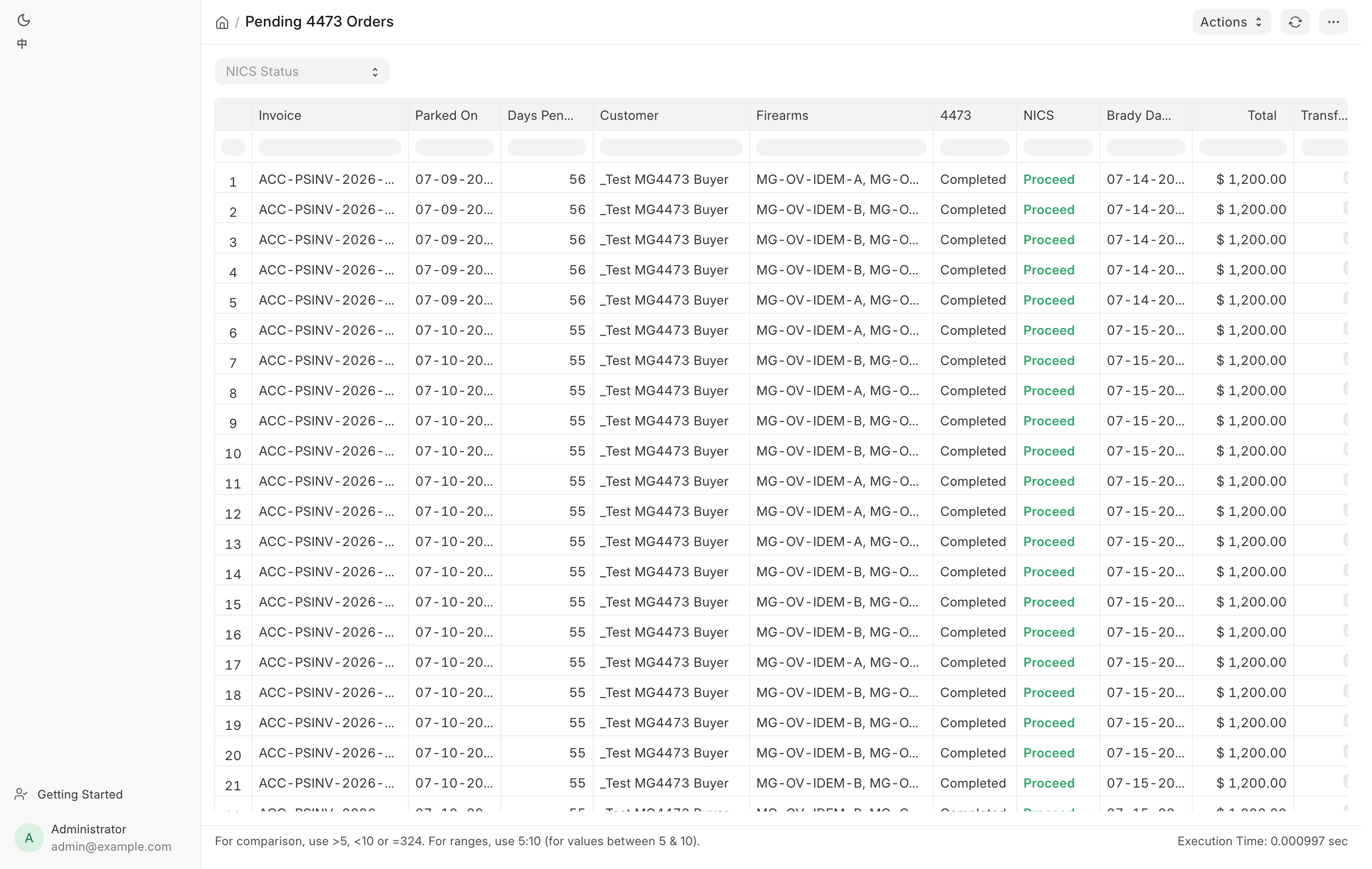
Work it in three passes:
- Denied. The NICS cell is red. The sale cannot go ahead. A manager refunds the card or returns the cash, then deletes the draft.
- Delayed with an orange Brady Day 3. The third business day has arrived and the check is still delayed. Federal law lets the dealer transfer at their discretion from that point. Decide, and call the customer either way.
- 4473 still Pending. Nobody finished the form. Call the customer, or chase whoever left it open.
Use the NICS Status filter to take one outcome at a time. Days Pending counts calendar days since the check started; Brady Day 3 counts three business days, stepping over weekends but not holidays.
A ticked Transfer? means the row is a customer transfer-in rather than a sale. The gun is already the customer's, so the conversation is different.
Detail is on Form 4473 and NICS.
2. Pending Transfer Pickups
Customers' guns sitting in the safe, oldest first. Every row is somebody else's property that the store is holding.
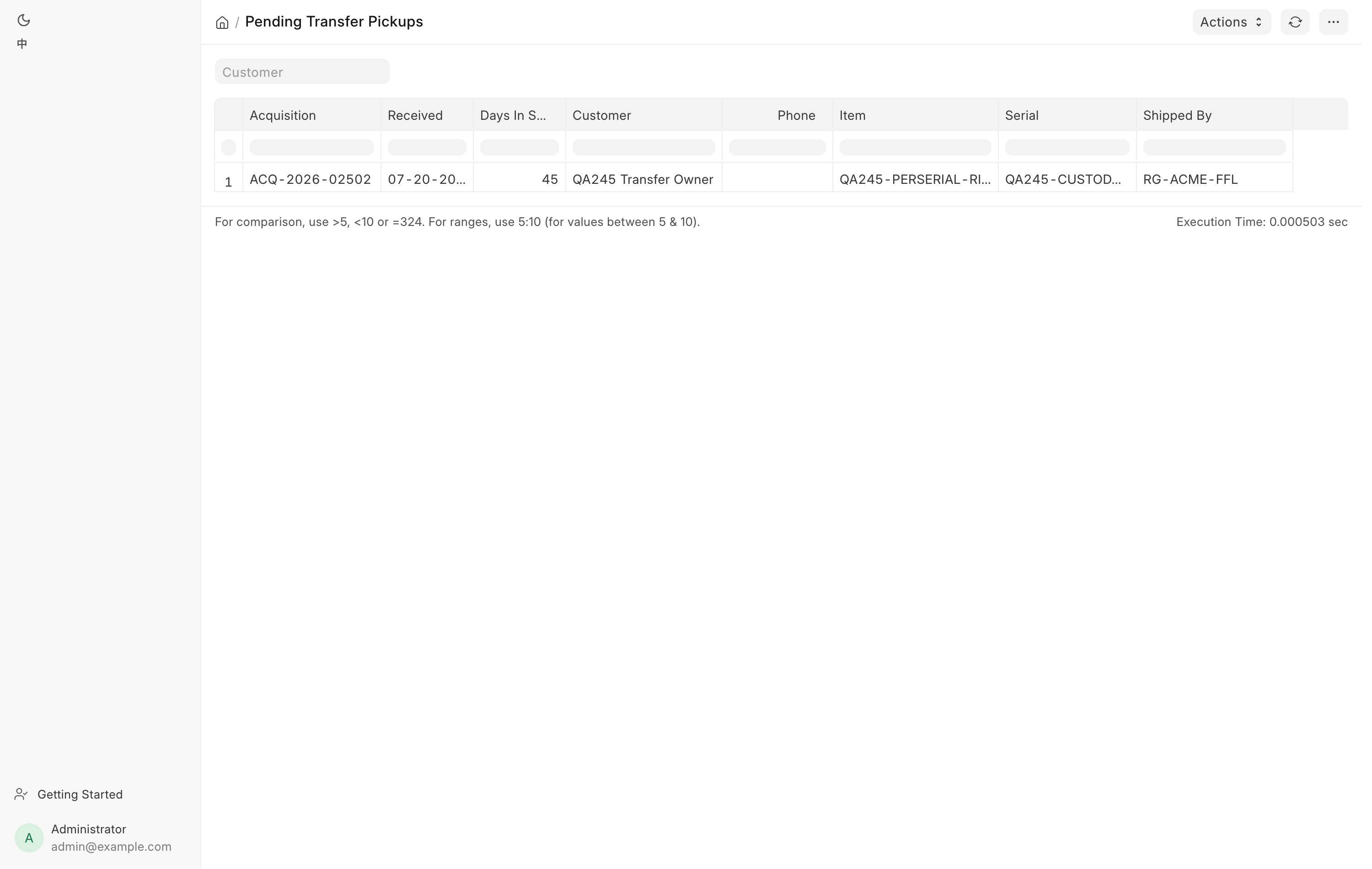
| Column | Use |
|---|---|
| Acquisition | The bound-book record. |
| Received | When the gun arrived. |
| Days In Store | Calendar days since. Sort by this. |
| Customer | Who to ring. |
| Phone | Their mobile number, blank when none is on file. |
| Item, Serial | Which gun. |
| Shipped By | Which dealer sent it. |
A row appears once a transfer has been received with a Transfer for Customer named, and disappears the moment the gun leaves stock. So the list clears itself when the customer collects.
Ring the top of the list. A gun with a high Days In Store is one nobody has chased, and a blank Phone is a customer record that needs fixing before it can be chased at all.
Filter by Customer when somebody rings you.
3. Hand-Asserted 4473 Dispositions
Every bound-book disposition somebody asserted rather than one FastBound committed. Two things land here: a manager's 4473 override, and a paper 4473 recorded at the counter.
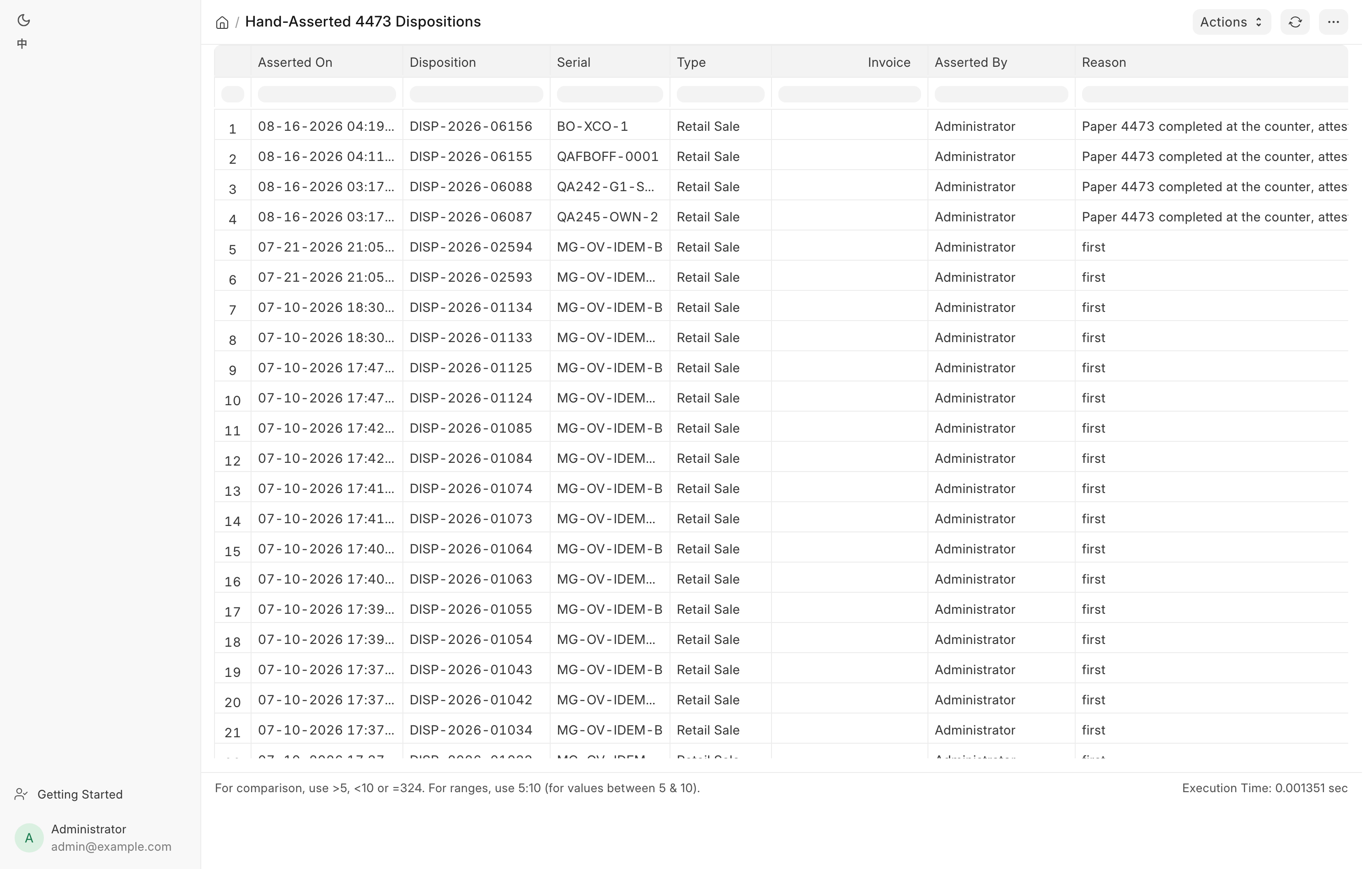
The columns are Asserted On, Disposition, Serial, Type, Invoice, Asserted By, Reason and FastBound ID. Newest first, capped at 500 rows. There are no filters. It is visible to System Manager and Sales Manager only.
Read each new row and ask three questions:
- Does the reason make sense? "FastBound down, form completed on the terminal" is a reason. A blank-looking one-word reason is not.
- Is the pattern normal? One override in a month is an incident. Several a week from one person is a habit worth a conversation.
- Did FastBound catch up? An empty FastBound ID means the bound book there still does not carry this disposition. In paper mode that stays empty by design. With FastBound running, an empty one after the fact means somebody needs to reconcile.
This is the whole control
An asserted disposition satisfies the sale gate exactly like a real one. Nothing downstream treats it differently. Reading this report back is the only thing that turns the override from a hole into an audited exception. If nobody reads it, "audited" only means "written down where nobody looks".
4. Firearms In Stock against FastBound
The two books have to agree about what is on the rack and what each gun is.
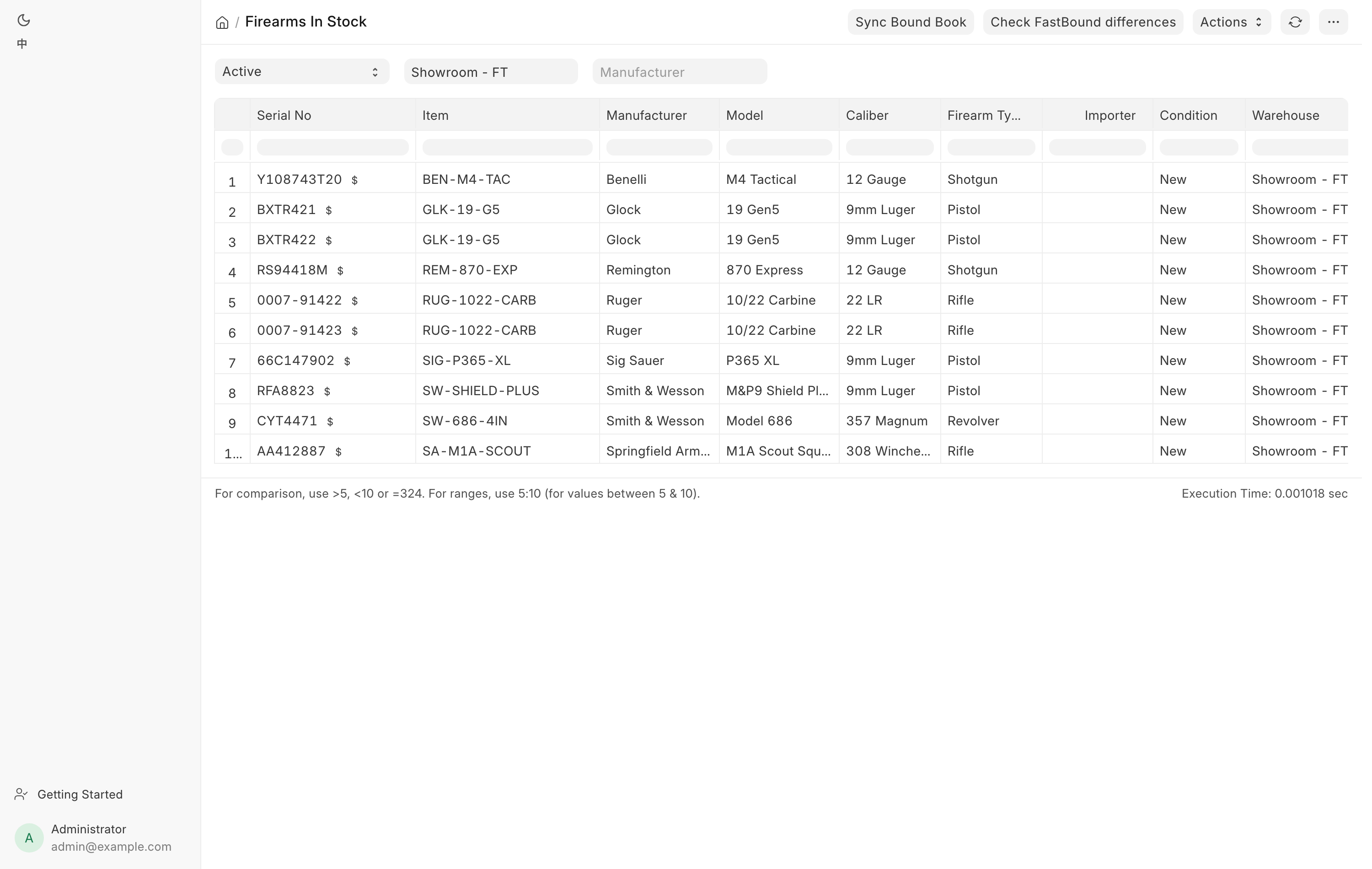
The report lists every serialized firearm, filtered by Stock Status (default
Active), Warehouse and Manufacturer. Manufacturer, model, caliber and
firearm type show the gun's own value where it has one, falling back to the
model's. Importer never falls back, so a blank importer column means that gun
carries no import marking.
The FastBound column links straight to the gun in the bound book, or shows a dash when the gun has no FastBound link at all. A dash on a regulated gun is itself a finding.
Two buttons do the comparison:
- Check FastBound differences compares each in-stock gun's identity fields against the bound book and reports which guns differ and in which fields. Fix each one from its Serial No with Sync with FastBound.
- Sync Bound Book finds guns that are in stock here but disposed in FastBound, and offers to issue them out. It previews first and only removes the guns you were shown. Consignment guns are never removed.
Both are covered in detail on FastBound.
Two mismatches to look for by eye while you are here:
- A gun on the rack that is not on the report. It was never received properly.
- A gun on the report that is not on the rack. It was sold or transferred without being booked out.
Where alerts go
The system does not rely on you opening these reports. It also pushes.
Email. Operational alerts go to the addresses listed in
FFL Settings under Alert Recipients, comma or
newline separated. Leave it empty and they go to every System Manager instead.
Every subject is prefixed [POS Alert].
The ones that matter here:
| Alert | When | How often |
|---|---|---|
[POS Alert] N FastBound record(s) stuck unsynced |
Any bound-book record carries a sync error | Once a day at most |
[POS Alert] N trade-in draft(s) not yet in the bound book |
A trade-in draft is older than today | Twice a day at most |
The trade-in reminder exists because of the next-business-day rule in 27 CFR 478.125(e). It runs whether or not FastBound is switched on, because the obligation is the store's. See Trade-ins.
Assigned to-dos. Some conditions raise an assigned task rather than an email, and those go to enabled users holding Stock Manager, Sales Manager or System Manager. A document that already has an open task does not raise a second one, so a recurring problem shows as one item, not fifty.
On the record itself. A serial mismatch between a 4473 and an invoice is posted as a comment on the order as well as raised as an alert, so whoever opens that order sees it.
Note
Set Alert Recipients to a real, monitored address. Left blank, these alerts go to every System Manager, which in practice is often nobody's inbox.