Shipping a consignment
A manager builds a shipment of the store's own guns, transfers them into a partner dealer's custody, and manages them from there until they sell or come back. This all happens on one page.
Before you start
- Open
/app/ship-consignment. You need the Sales Manager, Stock Manager or System Manager role. - The page lives at
/app/ship-consignment, not/app/consignment-out. The second address opens a plain list of records instead. - The dealer must already exist. See Onboarding a dealer.
- The dealer's FFL must be valid. You can build and save a shipment for a dealer whose license has lapsed, but nothing will transfer until it is fixed.
- Have the guns in front of you. You will be reading serial numbers off them.
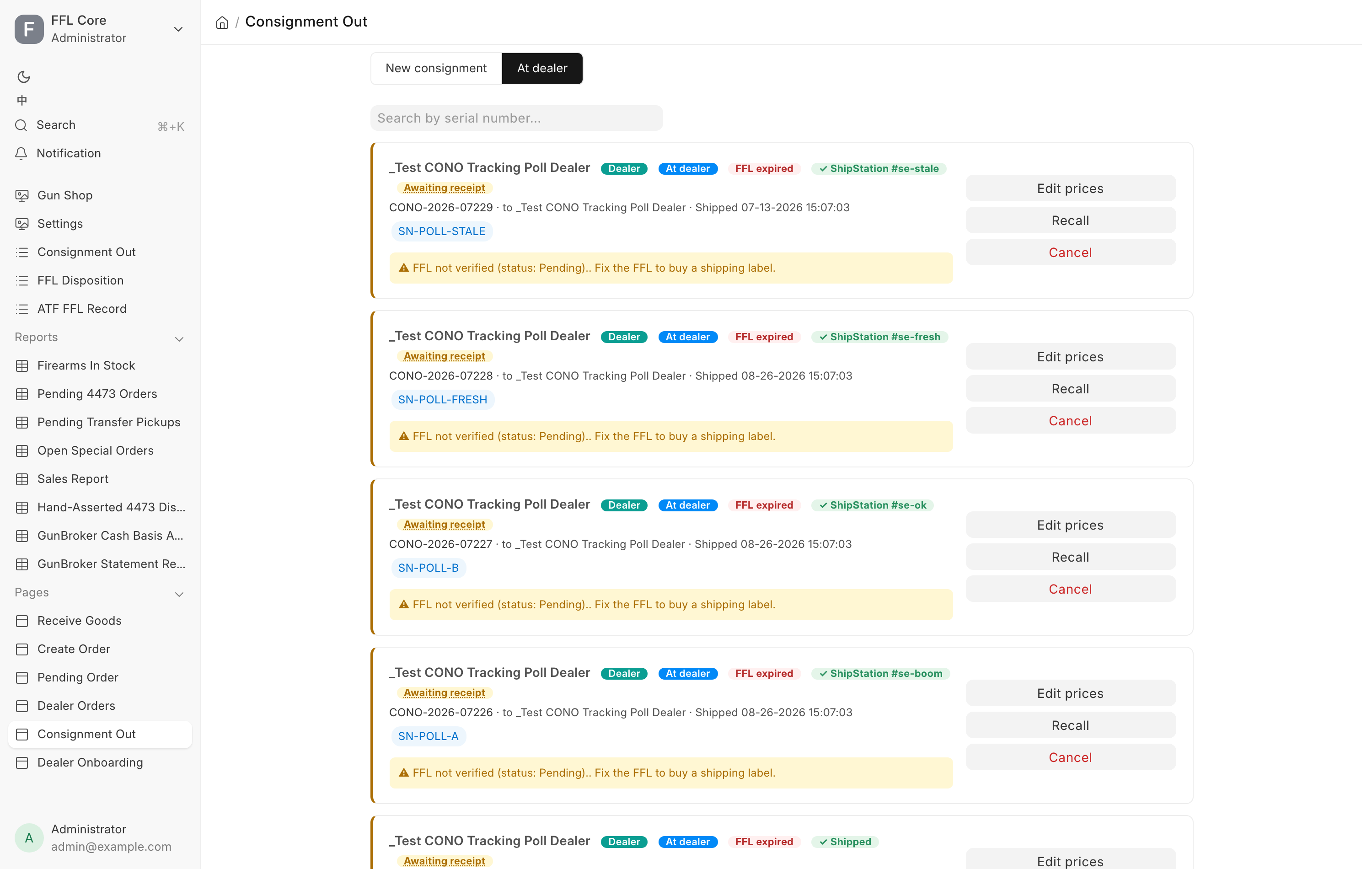
The page has two tabs. At dealer is the queue of everything not yet finished, and it is what opens first. New consignment is where you build one.
Building a shipment
- Under 1. Dealer, pick the partner FFL from the dropdown. A card appears under it showing their FFL number, its expiry, and either an FFL valid or an FFL invalid badge.
- Under 2. Firearms, type or scan into Add Firearm. Search by item code or by serial number.
- Pick a serial from the list that appears. Each row shows the serial, the warehouse it is in, its dealer price and its MSRP. Greyed rows cannot be picked, and the reason is printed beside them. See the table below.
- The gun joins the list with Dealer Price and MSRP already filled in. Both are editable. Dealer Price is what the dealer will owe you when the gun sells, so check it. MSRP is a suggestion you show the dealer, and can be left blank.
- Repeat for every gun. The running total at the bottom of the section is the total dealer price.
- Under 3. Fulfillment, choose one of two paths.
- Create only — dispose later is the default. The shipment joins the At dealer queue and the guns stay in your stock, held for it, until you dispose them.
- Dispose & ship now books the transfer immediately.
- Add a Consignment note (staff) if it helps whoever picks this up later. The note shows on the queue card.
- Click the primary button. It reads Save & queue on the create-only path and Review & ship on the dispose-now path. The line beside it tells you what is still missing.
Save draft saves and keeps you on the shipment so you can add more guns. The primary button clears the form for the next one.
Where the prices come from
Dealer Price is prefilled from the item's Cost field, or, for a gun priced individually rather than by model, from that serial's Dealer Sell Price. If it comes in blank or wrong, the field to fix is on the item or the serial, not the gun's acquisition cost. See the pricing section on the consignment index page. MSRP is prefilled from the gun's normal selling price.
Dealer Price must be greater than zero before you can dispose. Editing either price here changes this shipment only. The gun's own listing price is untouched.
Why a gun will not let you pick it
| Reason shown | What it means |
|---|---|
| Consignor-owned gun cannot be re-consigned. | The gun belongs to a private consignor. It can never go out to a partner dealer. |
| Already out on consignment. | It is already at a dealer. |
| Sitting in a consignment warehouse — flag out of sync, do not ship. | The record says it is free but it is physically in a consignment warehouse. Sort that out before shipping. |
| Reserved by … order … | A web or marketplace buyer already has a claim on it. |
| Held by another order. | A counter order is holding it. |
Consignor-owned guns are blocked on purpose
A gun taken in on inbound consignment is someone else's property. If it went out to a partner dealer, the consignor's payout would be calculated off the wholesale settlement price instead of a retail sale, and they would be short-paid without anyone noticing. The block is enforced twice, in the picker and again at the moment of transfer.
Disposing
Dispose is the moment the gun legally changes hands. It is a separate confirm step whichever path you took.
- The confirm dialog names the dealer, the destination FFL and its expiry, every serial with its dealer price, and the total.
- Tick I've verified the FFL and serial number(s).
- Click Dispose.
What the system does
For each gun in the shipment:
- Moves the stock into that dealer's consignment warehouse, creating the warehouse the first time you ship to them.
- Books a Dealer Transfer disposition in the bound book and pushes it to FastBound.
- Marks the serial as out on consignment, which takes it off your web store.
You still own the guns. Nothing is invoiced until the dealer marks one sold.
If ShipStation is switched on, the system also tries to create the shipment there so you can buy a label. If that part fails, the dispose still stands and you can push the label from the queue afterwards.
An invalid FFL degrades instead of transferring. If the dealer's license is not valid at the moment you dispose, the system saves the shipment as a held draft and transfers nothing. You get an amber notice saying so. The guns stay in your stock, nothing reaches the bound book, and the queue card carries a "Not transferred yet" warning. Fix the license, then press Dispose from the queue.
The At dealer queue
Every unfinished consignment appears here as a card, with the serials as pills you can read at a glance. The search box filters cards by serial number.
The badges on a card, left to right, are the dealer's name, a Dealer tag, the status, the FFL health, the shipping state and the receipt state.
| Badge | Meaning |
|---|---|
| Draft | Built but not yet disposed. Nothing has transferred. |
| At dealer | Disposed. The guns are in the dealer's custody. |
| FFL valid / FFL expired | Whether you can transfer or buy a label right now |
| Awaiting label | ShipStation is on and this has not been pushed yet |
| ✓ ShipStation | Pushed, label not bought yet |
| ✓ Shipped | A label was bought. Click it for tracking. |
| ✓ Shipped (manual) | Marked shipped by hand, outside ShipStation |
| ShipStation voided | The shipment was cancelled there |
| Awaiting receipt | At least one gun is not confirmed received by the dealer |
| Received ✓ | The dealer has confirmed every gun |
Click either receipt badge to see which guns are confirmed and which are not.
Every button on a card
Which buttons appear depends on the card's state.
| Button | When it appears | What it does |
|---|---|---|
| Dispose | The card still has draft lines | Books the transfer and the bound book entry. Described above. |
| Ship | Disposed, ShipStation is on, nothing pushed yet | Opens a confirm, then pushes the shipment to ShipStation so you can buy the label there. It does not dispose and does not touch the bound book. The dialog's own button reads Push to ShipStation. |
| Mark Shipped (no ShipStation) | Disposed, ShipStation on, nothing pushed yet | Clears the ship step without a push. Use it when the label was bought elsewhere. You can type a Tracking number (optional) and a free-text Carrier (optional), and the dialog's button reads Mark shipped. |
| Edit | Draft, nothing disposed | Reopens the shipment on the build form so you can add or remove guns. |
| Edit prices | At least one gun is at the dealer | Change Dealer Price and MSRP per gun for this shipment only. Save with Save prices. |
| Recall | At least one gun is at the dealer | Brings guns back. Described below. |
| Cancel | Always | On a draft card, cancels the whole thing. On a card with guns at the dealer, opens the void dialog. Both are described below. |
Edit prices only touches guns that are still at the dealer and not yet invoiced. It rewrites this shipment's snapshot, and the settlement invoice reads that same snapshot, so the dealer is billed the number you leave here. It does not change the gun's own price on your item or serial records, so the next consignment and your web store are unaffected.
Recall
Recall brings guns physically back from the dealer.
- Click Recall on the queue card. You can also open the shipment read only
at
/app/ship-consignment/<shipment name>, tick guns there, and use Recall selected. - Tick the guns to bring back. Only guns still at the dealer can be recalled.
- Leave Target warehouse (optional) blank to use your main warehouse, or pick a different one.
- Tick I understand this recalls the selected firearm(s) and click Recall.
The stock moves back, and the system books an Acquisition in the bound book and pushes it to FastBound. The gun really did come back into your inventory, so that entry is correct and permanent.
Void a line
Void is for a ship that should never have happened. The gun never left your store, and you are undoing the paperwork.
From the queue, click Cancel on a card whose guns are at the dealer. Tick the guns to void, type a Reason, tick the confirmation and click Void selected. You can void several guns at once this way.
One gun at a time, go to /app/ship-consignment/<shipment name>. That opens the
shipment read only, one row per gun, with a Void line button on each row.
A void cancels the gun's disposition and its stock transfer, deletes the FastBound disposition, and returns the gun to stock. Voiding requires a written reason, which is kept as the audit trail.
Void only when the gun never left the building
Void deletes a bound book entry. If the firearm actually was transferred to the dealer, that entry is a true federal record and must stand. Use Recall to bring the gun back instead, which books a matching acquisition. A gun whose settlement invoice already exists cannot be voided at all. The row shows a disabled Void line button and the note "Already invoiced — cancel the invoice instead."
Cancel a whole consignment
Only a draft can be cancelled whole, because a draft never touched stock or the bound book. Click Cancel on a draft card, type a Cancellation reason, tick the confirmation and click Cancel consignment. Every gun is released back to open stock and relisted on the web, and the cancelled record is kept as the audit trail.
A shipment that has already been disposed cannot be cancelled this way. Void or recall its lines individually.
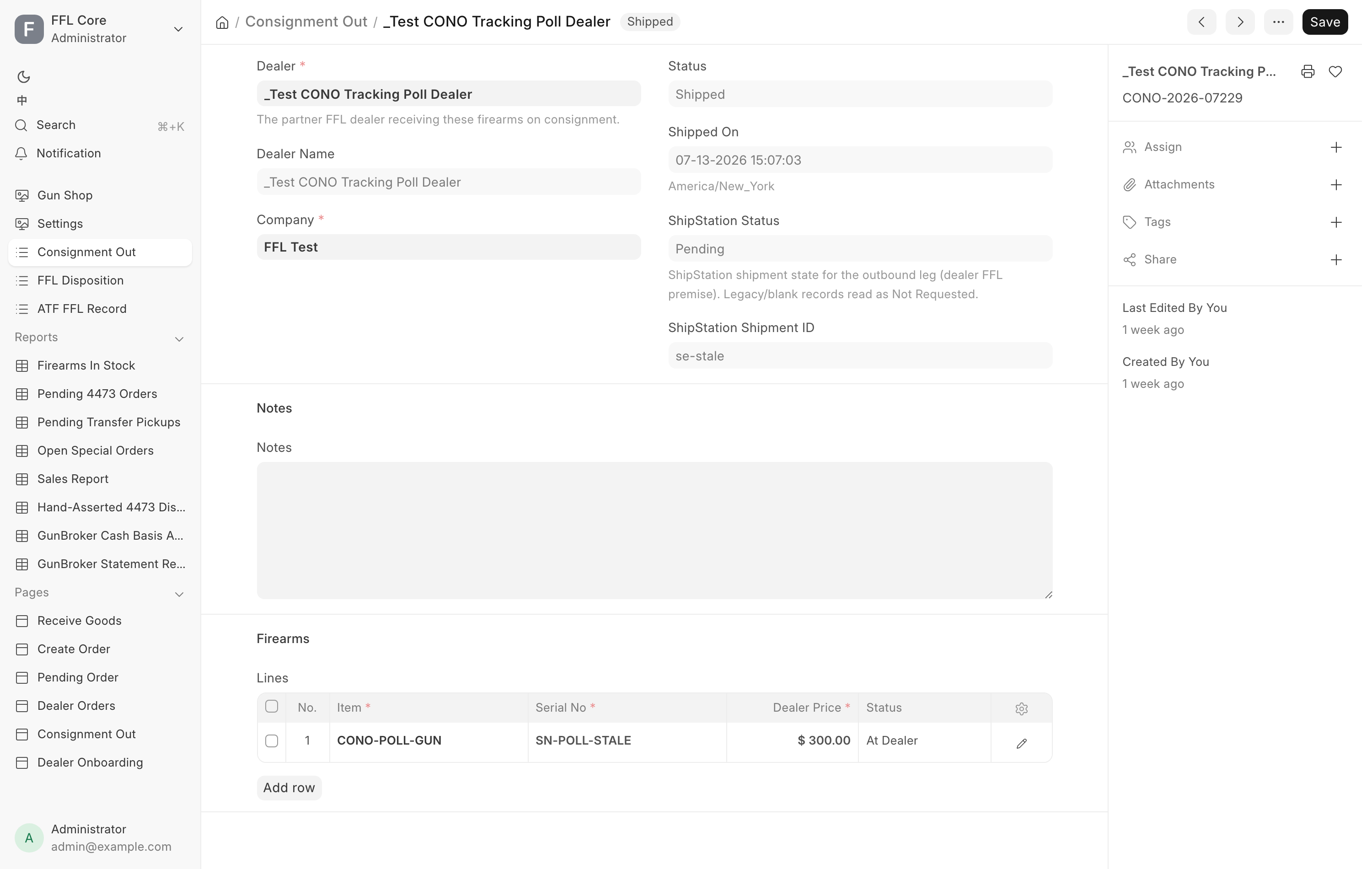
The shipment record
Clicking a shipment's name anywhere on the page opens its record, where you can read the whole history: the dealer, the destination FFL, the warehouse, the shipping and tracking fields, the staff note, and every gun with its status, prices, receipt stamps, stock entries, dispositions and settlement invoice.
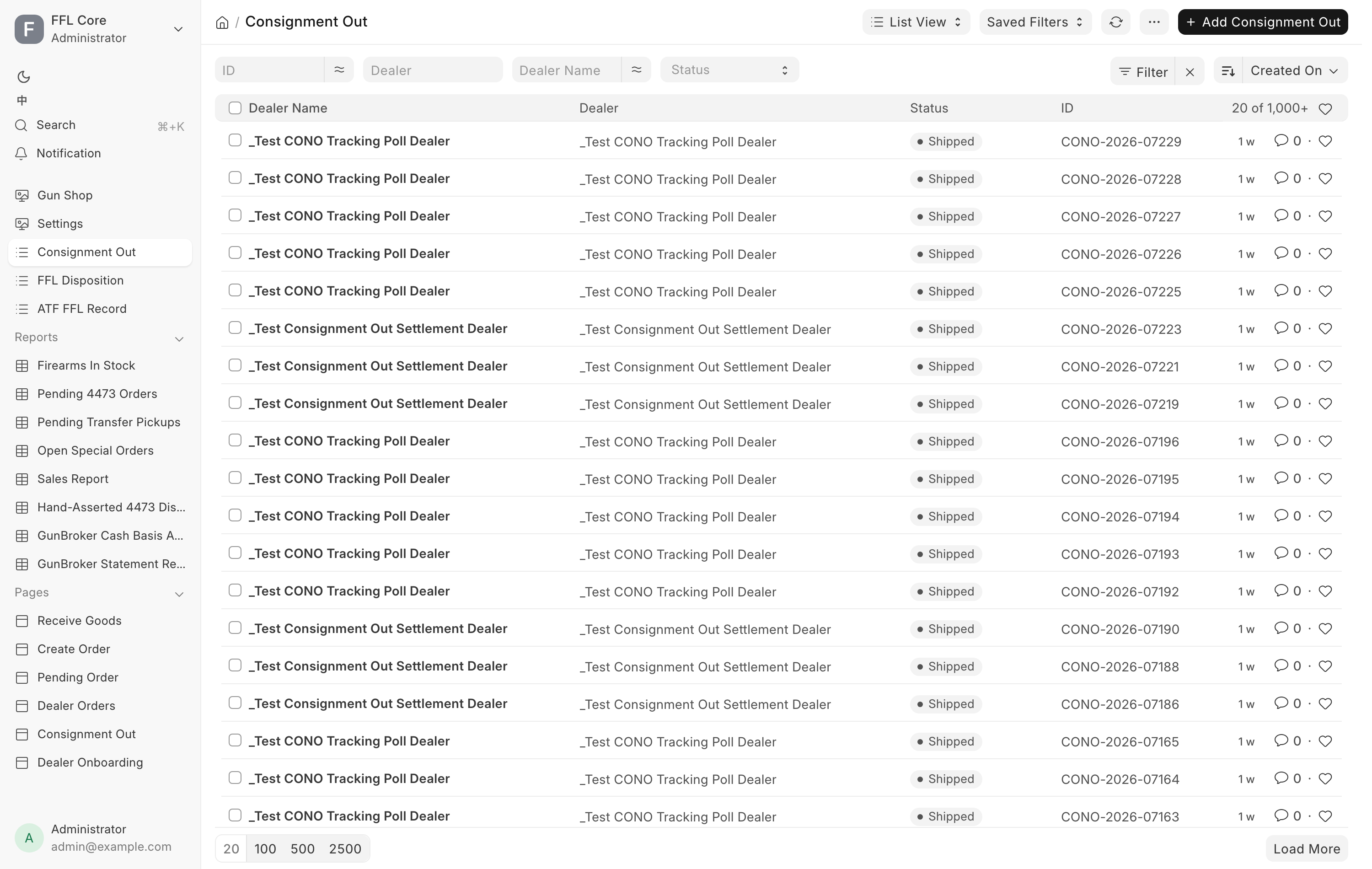
You can also browse them all as a list.
Troubleshooting
| Message you see | What it means | Fix |
|---|---|---|
| Dealer price must be greater than 0. | A gun has no settlement price | Type one, or fix the item's Cost field and re-add the gun. |
| Verify the FFL, then Dispose. | The dealer's license is not currently valid | Verify or renew it, then come back. See Verifying an FFL. |
| Saved as a draft — not transferred | You disposed against an invalid FFL | Fix the license, open At dealer and press Dispose. |
| FFL expired — fix it to buy a label. | You cannot push to ShipStation right now | Renew the license, or use Mark Shipped (no ShipStation). |
| Already invoiced — cancel the invoice instead. | The gun sold and was billed | Cancel the settlement invoice from Settlement and payout. |
| … is not a Draft consignment | You tried to cancel something already disposed | Void the at-dealer lines individually. |
| Line … is missing a serial or item code | A malformed row reached the save | Remove the row and re-add the gun. |