Receive Goods
The single page for booking stock in: distributor shipments, guns bought from a
private party, and customers' guns arriving for a transfer. Open it at
/app/receive-goods.
Before you start
- You need the Stock Manager or System Manager role to submit a receipt. The page also opens for Stock User, Purchase User and Purchase Manager, but the Submit & Receive button will fail without one of those two.
- For firearms from a dealer, the Supplier record must already be marked as an FFL dealer with a license number on file. See Verifying a dealer's license.
- Have the serial numbers in front of you. A firearm line cannot be added without one serial per unit.
- The Source list comes from FFL Settings. If the choice you want is missing, a manager adds it under FFL Settings.
Steps
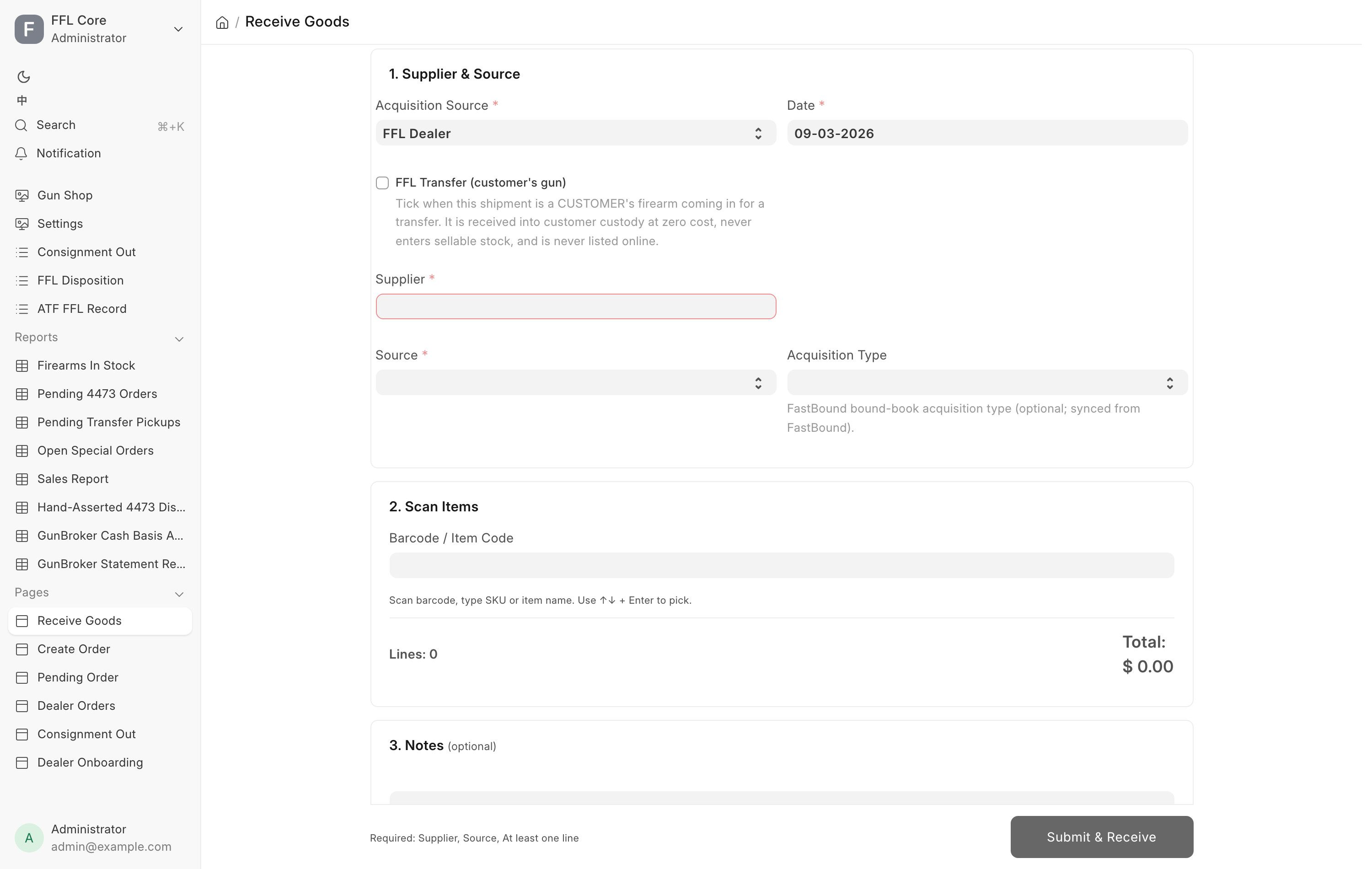
1. Say where the goods came from
- Set Acquisition Source. FFL Dealer is the default and covers every purchase from a licensed dealer or distributor. Choose Individual when the store is buying from a private party.
- Check Date. It is prefilled with today.
- For an FFL purchase, pick the Supplier.
- For an individual purchase, fill in the seller block that appears. Details are in Buying from a private party below.
- Pick a Source. This is your own procurement channel, not an ATF field.
The list is admin-managed and ships with
RSR,Distributor,Individual (trade-in),Manufacturer,ConsignmentandOther. - Pick an Acquisition Type if you use one. This is the FastBound bound-book acquisition type, and the list is pulled from your FastBound account. Leaving it blank lets the system fall back to a default derived from the source type.
Note
Choosing an Acquisition Type of Consignment changes two things. A
Consignment Commission % field appears, prefilled from the store
default, and every firearm line on the receipt may sit at a cost of $0
without being questioned. The store never bought a consignor's gun, so $0 is
the fact rather than a missing number.
2. Scan or search for the item
- Click into Barcode / Item Code and scan. The page reads the Item Barcode table first, then the item code.
- To find something without a barcode, type part of the SKU or the item name. The helper text under the box reads "Scan barcode, type SKU or item name. Use ↑↓ + Enter to pick." The dropdown also searches the distributor catalog and offers to create an item that does not exist yet.
- Picking a result opens a card for that line.
3. Fill in the line card
Every line asks for Qty, Cost and Sell Price.
- Cost is what the store paid per unit. It is required. See When a gun really was free if it is genuinely zero.
- Sell Price is optional on a firearm. Staff often do not know the tag price at the counter, and a manager can set it later per gun on the Item form's Serial Numbers tab. On a non-firearm item, or on a firearm marked Uniform Pricing, whatever you type here becomes the item's selling price and reaches the register.
A firearm line asks for more:
| Field | Notes |
|---|---|
| Serial Number(s) | One serial per line of the box. The count must match Qty. |
| Manufacturer | Required. Picked from the Brand list. |
| Model | Required. |
| Type | Required. The ATF firearm-type vocabulary. |
| Caliber | Required. Picked from the Caliber list. |
| Importer | Only for imported guns. Starts blank on every receive. |
| Antique (pre-1899 / GCA-exempt) | See Antique firearms. |
| Year Made | Appears only while Antique is ticked. Optional. |
Manufacturer, Model, Type and Caliber are prefilled from the catalog where the system knows them, but you confirm them here because they are what the bound book records. Importer is never prefilled. An import marking belongs to one physical gun, so you state it for the gun in front of you or leave it blank.
Tick Service needed (gunsmith / repair) if the unit needs work before it can be sold. That flag lands on each Serial No and shows as a pill on the Item form's Serial Numbers tab, where the gunsmith clears it.
Click Add to Receipt. The line drops into the table and the scanner box takes focus again for the next item.
4. Review and submit
- The table shows Item, Qty, Cost and Subtotal, with a FIREARM mark and the serials under each gun line. An antique also carries an ANTIQUE mark.
- Click any row to reopen it for editing, then Save or Cancel. Click Remove to drop the line.
- Add anything worth recording under Notes.
- The line above the button tells you what is still missing. When it reads "Ready to receive." the button unlocks.
- Click Submit & Receive.
On success a green message names the Purchase Receipt, and the page clears itself for the next shipment.
Buying from a private party
Set Acquisition Source to Individual and the Supplier picker is replaced by the seller block. Everything in it is required, because 27 CFR 478.125(e) requires the non-licensee transferor's name and address in the bound book.
| Field | Notes |
|---|---|
| Seller (Customer) | The private party's customer record. Picking one prefills the name and address fields below. |
| Seller First Name / Seller Middle Name / Seller Last Name / Suffix | Middle name is optional. The names are captured separately because FastBound records them separately. |
| Seller ID Type | Driver License, State ID, Passport, Military ID, Other. |
| Seller ID Number | Required. |
| Seller ID Document | Optional photo or scan of the ID. Stored privately. |
| Street Address, City, State, ZIP | Required, as printed on the ID. The state must be the two-letter code and the ZIP a real ZIP. |
The Purchase Receipt is booked against a placeholder supplier named
Individual Seller, which the system creates on first use. The real seller,
their ID and their address live on the FFL Acquisition, which is where an
auditor looks. The FFL-dealer checks are skipped on this path.
Federal recordkeeping
An uploaded Seller ID Document is forced private on the way in. Do not attach a government ID to any other field, and do not put it in a photo gallery. Photo galleries are made public so the web store can read them.
Customer transfers
Tick FFL Transfer (customer's gun) when the shipment is a customer's firearm arriving from another dealer for a transfer. A Transfer for Customer picker appears. Name the person who will collect the gun, so the Pending Transfer Pickups report can age it.
Ticking the box changes what happens to the whole document:
- Every line is received into the customer-custody warehouse, not sellable stock.
- The Cost and Sell Price boxes are locked at zero. The store did not buy this gun, so it is worth nothing on our books and it is not for sale at any price.
- Only serialized firearms are allowed on the document. A customer's accessory is their property and purchased goods belong on a separate receive.
- Each gun is flagged so no channel can list it online.
If you untick the box after adding lines, those lines become ordinary purchases at $0 and the page asks you for a real cost before it will submit again.
Selling the transfer service itself happens at the register. See Transfers.
When a gun really was free
A cost of $0 that nobody confirmed cannot be told apart later from a cost nobody looked up, so the page asks. Leave Cost at zero and three controls appear:
- Tick Cost really was $0. Tick it only when the store truly paid nothing, such as a supplier gift, a promotion or a warranty replacement. A cost nobody has looked up yet gets entered, not confirmed.
- Pick a Zero Cost Reason:
Supplier gift,Promotional item,Warranty replacement,SampleorOther. - Reason
Otheralso requires one line under What happened, so a later stock-cost audit can read it instead of asking.
The confirmation, the reason and the note are stored on the receipt line and, for a firearm, on each Serial No. Two cases skip the question entirely: a customer transfer, where the cost is forced to zero anyway, and a consignment intake, where $0 is the correct answer.
Antique firearms
Antique (pre-1899 / GCA-exempt) marks a gun that is still serialized inventory but is not a regulated firearm. It is tracked with a serial number and appears on Firearms In Stock, but no bound-book acquisition is written, nothing is pushed to FastBound, and no Form 4473 or NICS check happens when it sells.
Year Made appears only while the box is ticked. It is optional provenance behind the exemption and never blocks the receive. An out-of-range year is dropped rather than rejected.
An item is antique or it is not, as a whole. Two lines of the same item with different Antique settings are refused. If the item already has guns in the bound book the checkbox is disabled, with the note "Already in the bound book — cannot be marked Antique (a booked gun leaves only via a disposition)."
What the system does
Submitting is one transaction. Either everything below happens or nothing does.
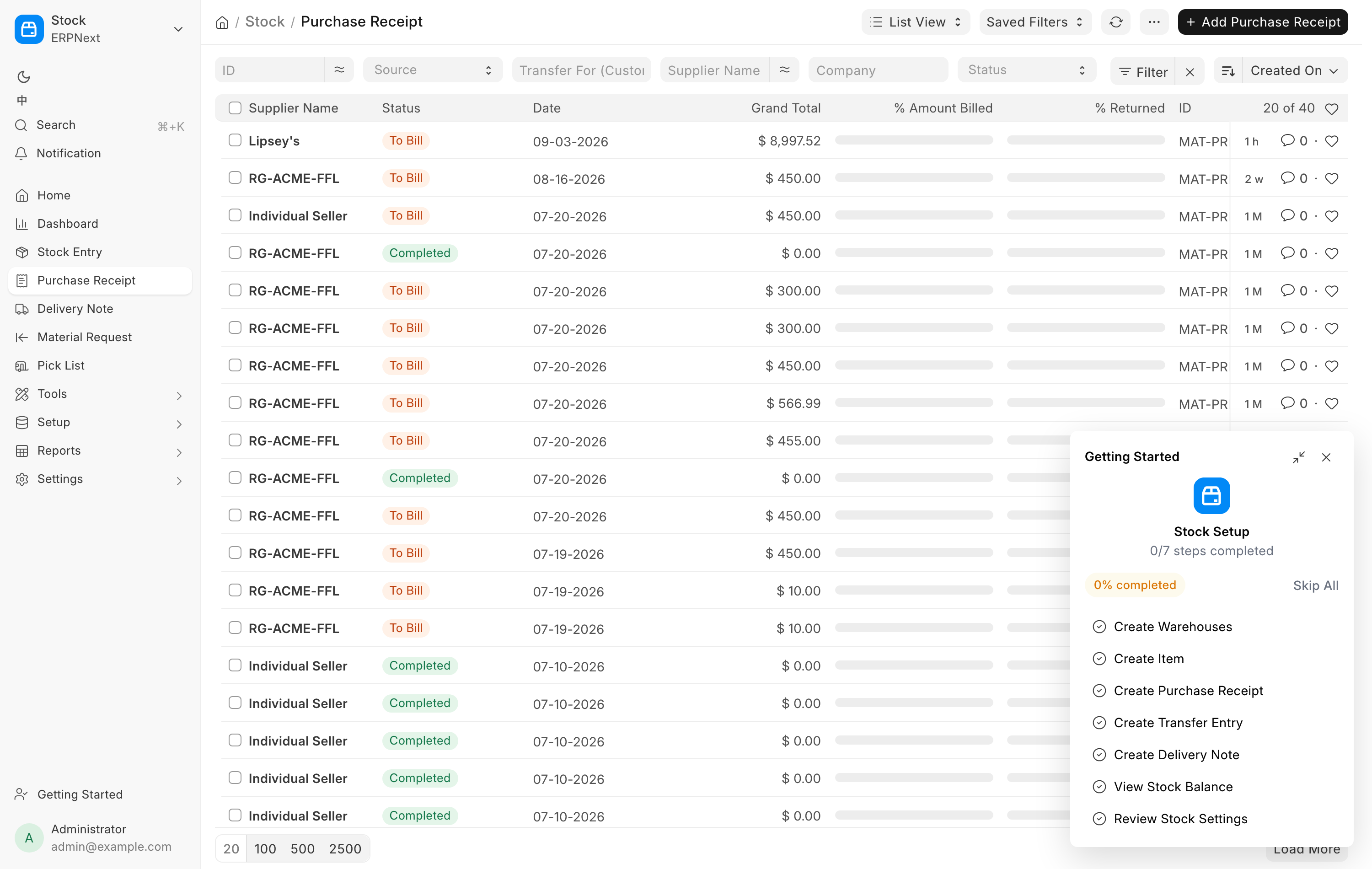
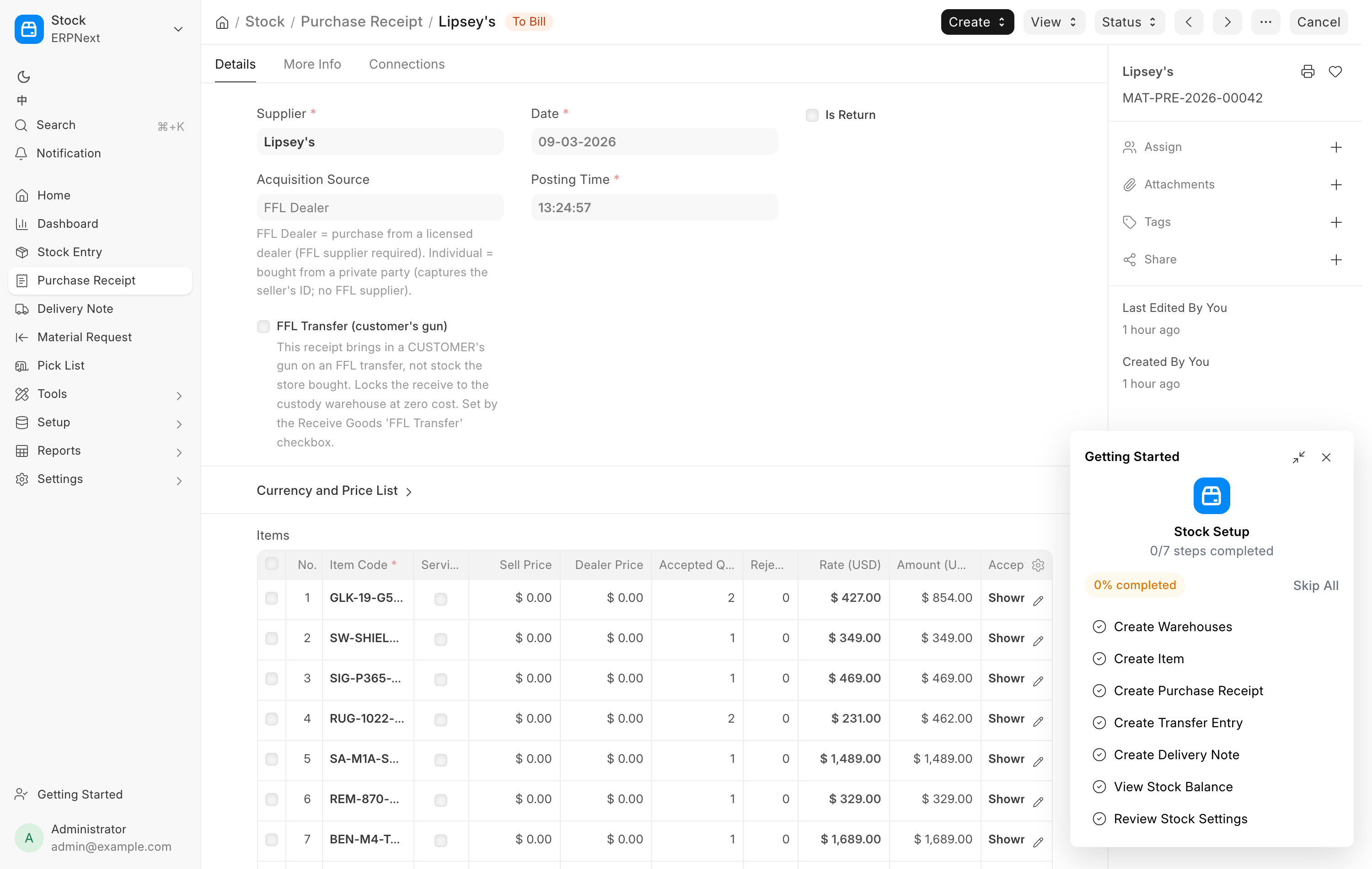
- Creates and submits a Purchase Receipt. Stock moves, and the receipt is the source document for the whole receive. Find it later under Purchase Receipt or on the Inventory Receipts report.
- Writes the bound-book acquisition. For each firearm serial that is not an antique, one submitted FFL Acquisition record is created. That is the A side of the book: date, source, item and serial.
- Pushes to FastBound. The push runs synchronously, inside the same transaction. If FastBound rejects the firearm, the Purchase Receipt, the Serial No records, the stock movement and the acquisitions are all rolled back together, and you see the reason. The gun enters FastBound and our stock or it enters neither.
- Stamps each Serial No. Manufacturer, importer, model, caliber and year made land on the individual gun, along with the cost, the sell price, the service flag and any zero-cost confirmation.
- Updates the item. Model, caliber and firearm type are kept current on the item because they define the model. Manufacturer seeds a blank item and never overwrites one. Importer is never written to the item.
- Applies the Sell Price. On a non-firearm item, or a firearm with Uniform Pricing, the price you typed becomes the item's selling price and the register's price. A per-gun firearm stamps it on the serial instead. A customer transfer writes no price anywhere.
- Records the consignor. On a Consignment acquisition, each serial is marked as consignment stock with the consignor and the commission percentage.
The FFL gate
A firearm line cannot be received from a supplier who is not a verified FFL dealer. The check runs on the Purchase Receipt itself, so it applies however the receipt was built.
If the supplier is not marked as a dealer you see:
Cannot receive firearm from supplier '<name>' — not registered as FFL Dealer.
Open the Supplier form and use 'Search ATF' to populate FFL information.
Do exactly that. Open the Supplier, tick Is FFL Dealer, use Search ATF to fill the license details from the ATF directory, then Verify FFL to confirm against the live check. See Verifying a dealer's license.
A status of Pending is accepted at receiving time, so a clerk's first receipt
from a newly created supplier is not blocked. Failed and Expired are not
accepted.
Troubleshooting
| Message you see | What it means | Fix |
|---|---|---|
Cannot receive firearm from supplier '<name>' — not registered as FFL Dealer. |
The supplier has no FFL on file. | Open the Supplier, use Search ATF, then Verify FFL. |
Supplier '<name>' is marked as FFL Dealer but has no FFL Number on file. |
The dealer checkbox is ticked but the license number is blank. | Fill in the FFL Number, or run Search ATF again. |
Supplier '<name>' EZ Check status is '<status>'. Re-verify the FFL before receiving firearms. |
The last verification failed or the license expired. | Run Verify FFL on the Supplier. |
Need N serial(s), got M. |
The serial box does not match Qty. | One serial per line, no blank lines. |
Firearm details required: ... |
Manufacturer, Model, Type or Caliber is blank. | Fill in the named fields on the card. |
Row #N: cost of $0 for <serial> needs confirming. |
A zero cost with no confirmation. | Enter the real cost, or tick Cost really was $0 and pick a reason. |
Row #N: <serial> is marked as $0 but carries a cost of <amount>. |
The free tick and a price contradict each other. | Clear the cost, or untick Cost really was $0. |
Row #N: '<item>' is not a serialized firearm, so it cannot be received on an FFL Transfer. |
A non-gun line on a transfer document. | Split the document. Purchased goods get their own receive. |
Item '<code>' appears on multiple lines with conflicting Antique settings |
The same item is on two lines, one ticked antique and one not. | Receive it under one classification. |
| FastBound rejected the receive and nothing was booked | The bound-book push failed, so the whole receive was undone. | Read the message, fix the firearm details or the supplier's FFL, and receive again. |
Related pages
- Trade-ins for taking a gun in against a sale.
- Items and serials for pricing and describing what you received.
- Corrections if something went in wrong.
- The bound book for what the acquisition record holds.