Point of Sale
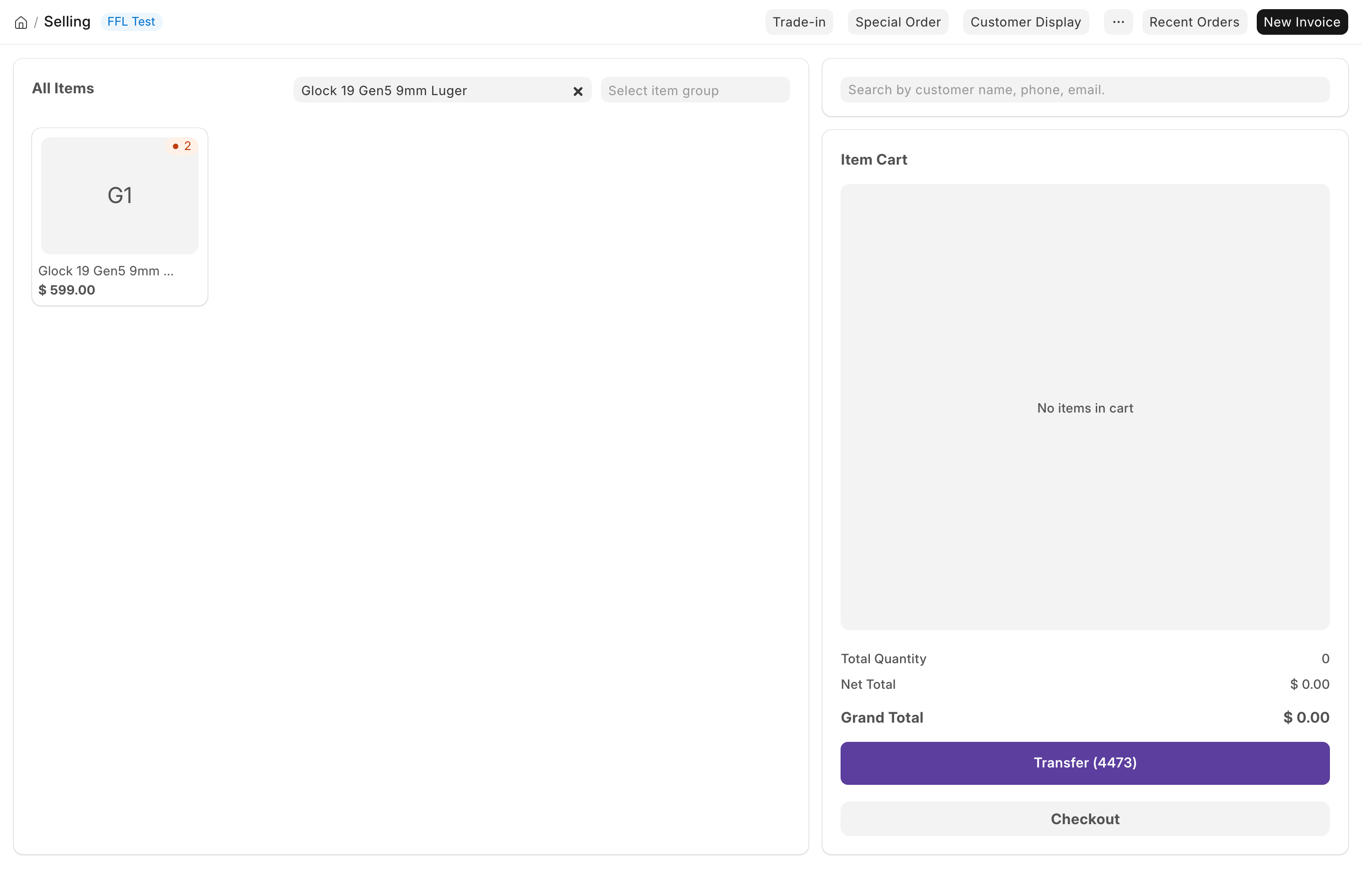
The register. Counter staff use this for every walk-in sale. It opens from the
Open POS tile on the Gun Shop workspace, or at /app/point-of-sale.
Before you start
- You need Sales User or Sales Manager. The register is ERPNext's own page and also opens for Accounts User and Accounts Manager. See Who can do what.
- A shift has to be open on the register. If none is, the system asks you to open one, and that is the first section below.
- Running a Form 4473 needs a narrower role than ringing a sale. An Accounts User can open the register but cannot run a 4473.
Opening a shift
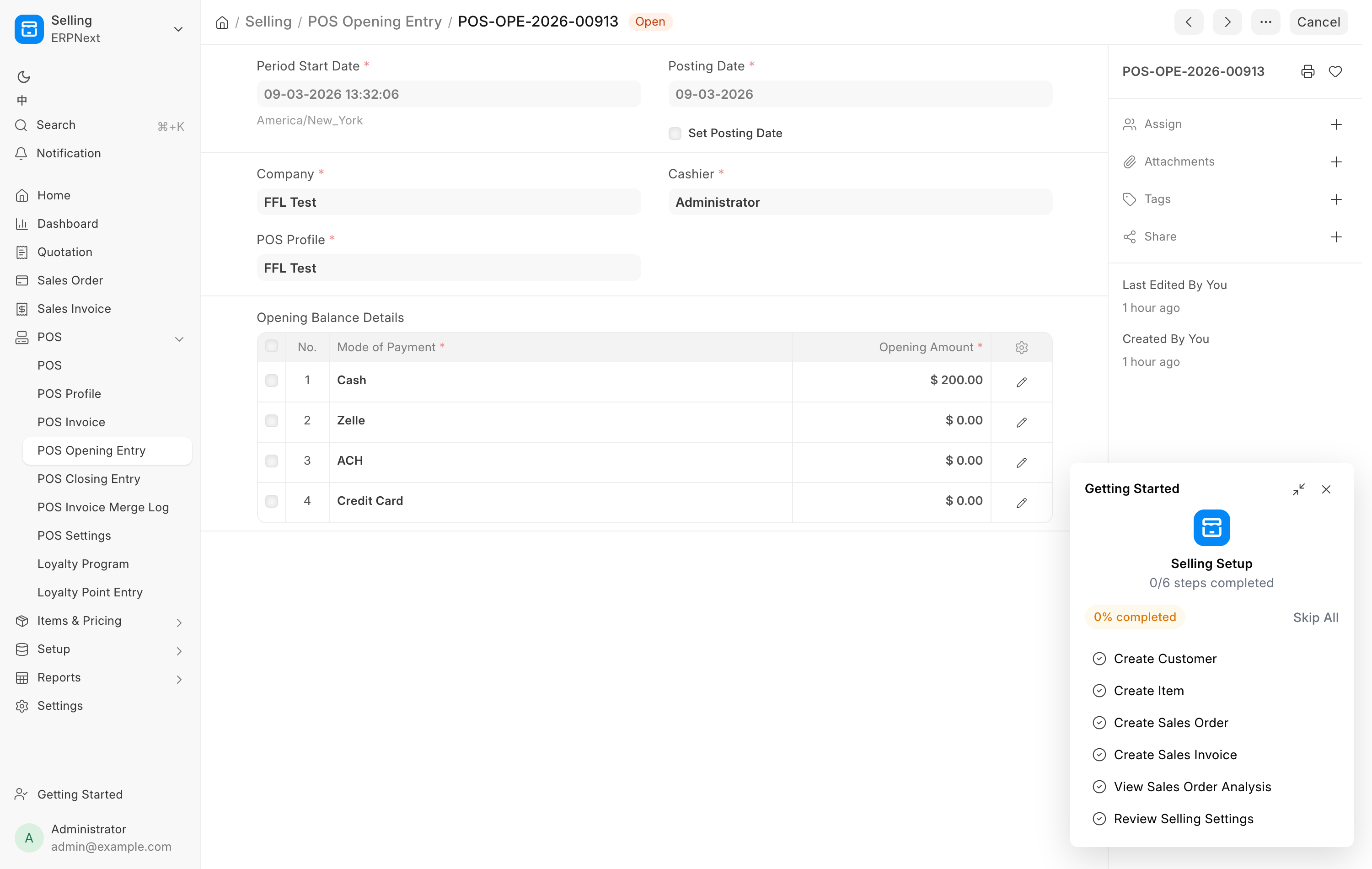
When you open the register and no shift is running, the Create POS Opening Entry dialog appears.
- Check Company.
- Pick the POS Profile for this register.
- In Opening Balance Details, enter the Opening Amount you counted for each mode of payment. Cash is the one that matters. Leave the rest at zero.
- Click Submit.
That creates a POS Opening Entry and the register opens. Everyone else working the counter joins the same shift rather than opening a second one. See Opening and closing the day.
Ringing up non-firearm items
- Scan the barcode, or type part of the name into the item search and click the product card.
- The line lands in the cart on the right. Click the line to change quantity or price in the Item Details panel.
- Pick the customer at the top of the cart. A walk-in can stay on the default customer unless you need the sale on their record.
- Click Checkout.
Ammunition, optics, holsters and cases have no 4473 and no bound-book entry. They post to stock at the nightly close rather than at the moment of sale, which is normal and is what Opening and closing the day explains.
The three extra buttons
Three buttons sit in the page toolbar at the top of the register, to the left of Recent Orders:
| Button | What it does |
|---|---|
| Trade-in | Books a gun the customer is trading in and puts the allowance on the ticket. See Trade-ins. |
| Special Order | Orders something the store does not stock, or rings up the pickup of one. See Special orders. |
| Customer Display | Opens the customer-facing screen. |
Customer Display opens a second browser window that mirrors the cart for the customer to read: the items, the totals and the payment stage. Put it on the second monitor and leave it open. It follows the cart on its own, so there is nothing to press again during a sale. If nothing opens, the browser blocked the popup. Allow popups for this site and click Customer Display again.
A fourth button, purple and labeled Transfer (4473), sits on the cart above Checkout. That one is for a customer's own gun arriving from another dealer. See Customer transfers.
Picking the gun: the serial picker
Most guns in this store are priced per unit, not per model. Two used rifles of the same model can carry different prices, because the price lives on the individual Serial No record rather than on the Item.
That changes how you add one to a cart:
- The product card for a per-gun priced firearm shows a price range, for
example
$549.00 – $799.00, instead of one price. - Click it. The line goes into the cart and the Item Details panel opens by itself with the serial numbers listed above the serial field. Each entry shows the serial and that gun's own price.
- Pick the gun you have physically taken off the rack. The cart line reprices to that gun's price.
The dropdown starts on — pick in-stock serial — with an orange border and the reminder that per-gun pricing needs a serial to price the line. It picks for you in only two cases: the item is uniform priced, so every unit costs the same, or there is exactly one unit in stock.
Pick the gun you are actually handing over
The serial you choose is the serial that goes on the 4473 and out of the bound book. Scanning the barcode on the gun itself is the reliable way to get it right.
If you try to check out with a per-gun firearm line that has no serial, or whose price is still zero, the register stops you with Pick the gun and names the item. Open the line, pick the serial, and check out again.
Held and draft orders
An order that cannot finish yet becomes a Draft and waits. That happens for firearm sales parked for a 4473 or a background check, for transfers, and for a deposit invoice nobody collected.
To come back to one, click Recent Orders in the toolbar and set the status filter to Draft. Open the order and carry on where you left off.
Money already taken is kept
A firearm order can be paid before the 4473 clears, so a held draft may already carry a card capture or a cash and Zelle split. When you reopen it, the system keeps that recorded tender instead of resetting the payment lines to the register's defaults. You do not re-enter the payment, and you must not charge the card a second time.
Completing a cash sale
- Click Checkout. The payment screen opens.
- Click Cash and enter the amount tendered. The screen shows the change to give.
- Click Complete Order.
The receipt prints, the cart clears and the register is ready for the next customer. For cards, Zelle, split payments and refunds, see Taking payment. For anything with a gun on the ticket, read Selling a firearm first.
Troubleshooting
| Message you see | What it means | Fix |
|---|---|---|
| Pick the gun | A per-gun priced firearm line has no serial, or its price is still zero | Open the cart line and pick the serial in Item Details |
| Add items to the cart first. | You started a 4473 on an empty cart | Add the firearm line, then start the 4473 |
| Customer required | The action needs a named customer | Pick the customer at the top of the cart |
| Popup blocked, allow popups then click Customer Display again | The browser refused the customer screen | Allow popups for this address and click the button again |
| POS not ready. | The register had not finished loading | Wait for the page to settle and click again |