The bound book
Two record types hold the acquisition and disposition book: FFL Acquisition for a gun coming in, FFL Disposition for a gun going out. Both are created for you by the pages you already use.
You do not normally create these by hand
Every routine path writes them:
- Receive Goods writes one FFL Acquisition per firearm serial when the Purchase Receipt submits.
- Trade-ins writes one when the trade books.
- The register writes the disposition for a retail sale, once the 4473 is complete.
- The Pending Order queue and the shipping flows write the disposition for a dealer transfer or a web order.
Open the lists to read them, search them and check a gun's history. Creating one by hand is for the rare case a routine path cannot reach, and the forms refuse several shapes outright to keep that honest.
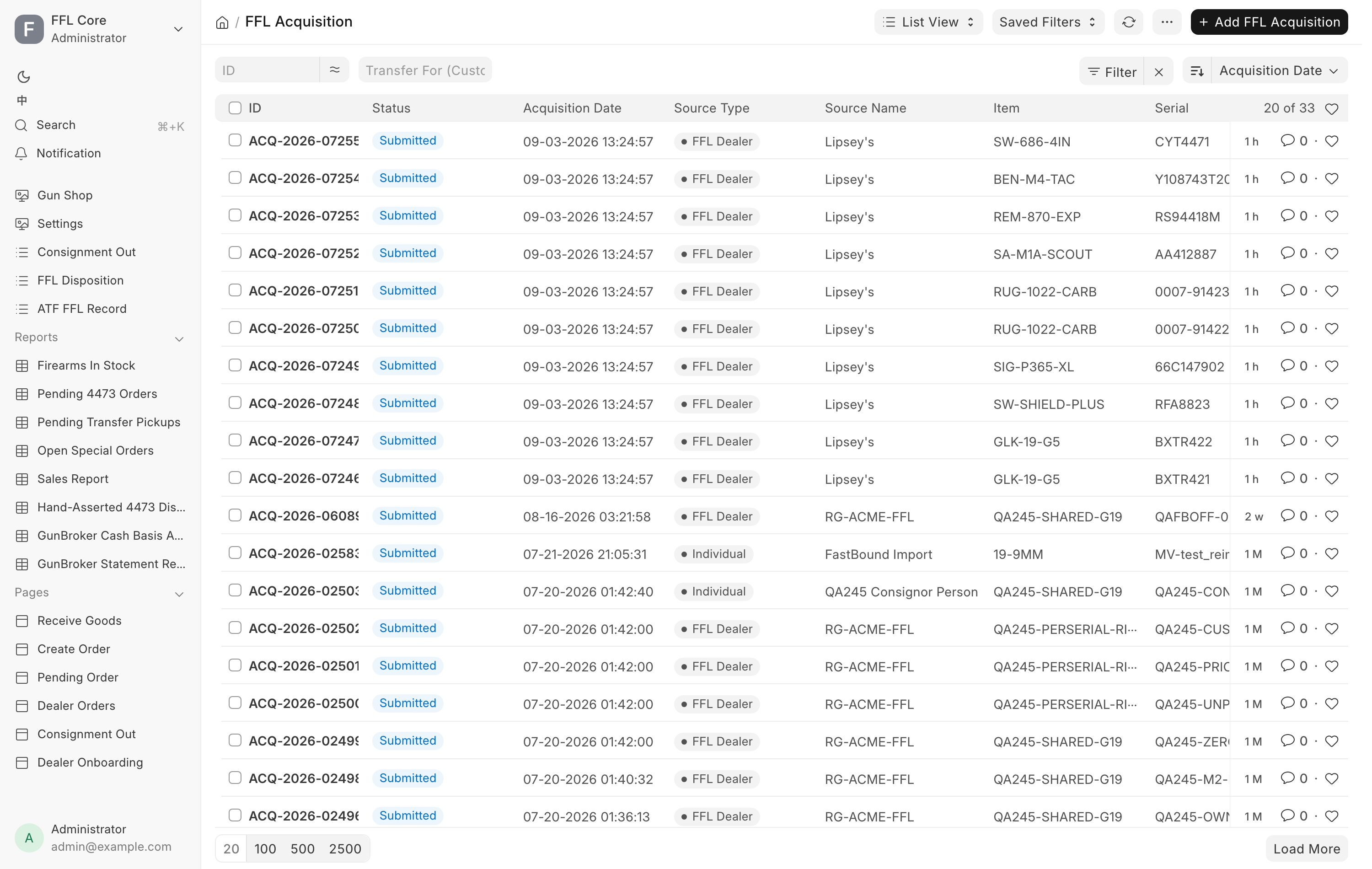
FFL Acquisition
The A side. One record per physical gun received, named ACQ-<year>-<number>.
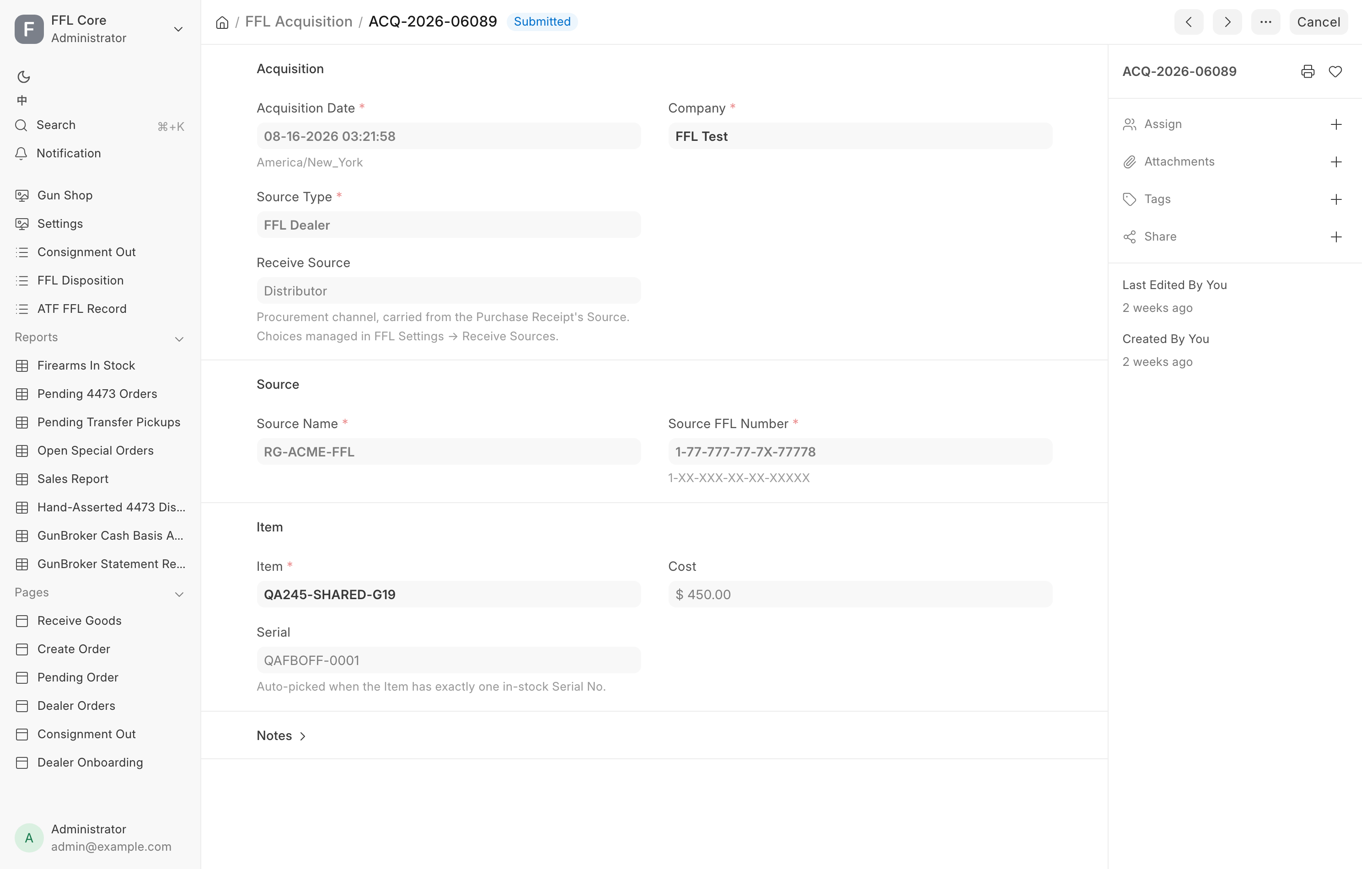
Acquisition
| Field | Notes |
|---|---|
| Acquisition Date | Required. When the store took possession. |
| Source Type | Required. See below. |
| Receive Source | Your own procurement channel, carried from the Purchase Receipt. The list is managed under FFL Settings. |
| Acquisition Type | The FastBound acquisition type. The list is synced from your FastBound account. Blank falls back to a default derived from the source type. |
| Company | Required. |
Source Type options are Individual, FFL Dealer, Manufacturer,
Importer, Estate, Pawn and Trade-in. The choice drives what the form
demands next.
Source
Who the gun came from. Which fields show depends on the source type.
| Field | Shown for |
|---|---|
| Source Name | Always. Required. |
| Source First Name, Source Middle Name, Source Last Name, Source Suffix | Individual, Trade-in, Estate, Pawn. FastBound records a private seller's name in parts. |
| Source Address | Always. |
| Source FFL Number | FFL Dealer only, and required there. Format 1-XX-XXX-XX-XX-XXXXX. |
| ID Type, ID Number | Individual, Trade-in, Estate, Pawn. |
| Seller (Customer) | Individual, Trade-in, Estate, Pawn. Links to the customer record. |
| ID Document | Individual, Trade-in, Estate, Pawn. Stored privately. |
| Transfer For (Customer) | Always. Set when the gun arrived as a customer transfer-in. Drives the Pending Transfer Pickups report. |
The form refuses two shapes. A dealer source with no license number is rejected
under the title FFL Required: "Source FFL number is required when source type
is 'FFL Dealer'." A private-party source with no identification is rejected under
ID Required: "ID type and number are required for source type '
Item
Item, Serial and Cost. The serial is filled in automatically when the item has exactly one in-stock serial.
FastBound Sync
FastBound ID, Last Synced and FastBound Sync Error are read-only. See FastBound for what they mean and what to do when the error field is not empty.
Submitting the record is what puts the gun in the book. Amending means cancelling and creating a replacement that names the original.
FFL Disposition
The D side. One record per gun leaving, named DISP-<year>-<number>.
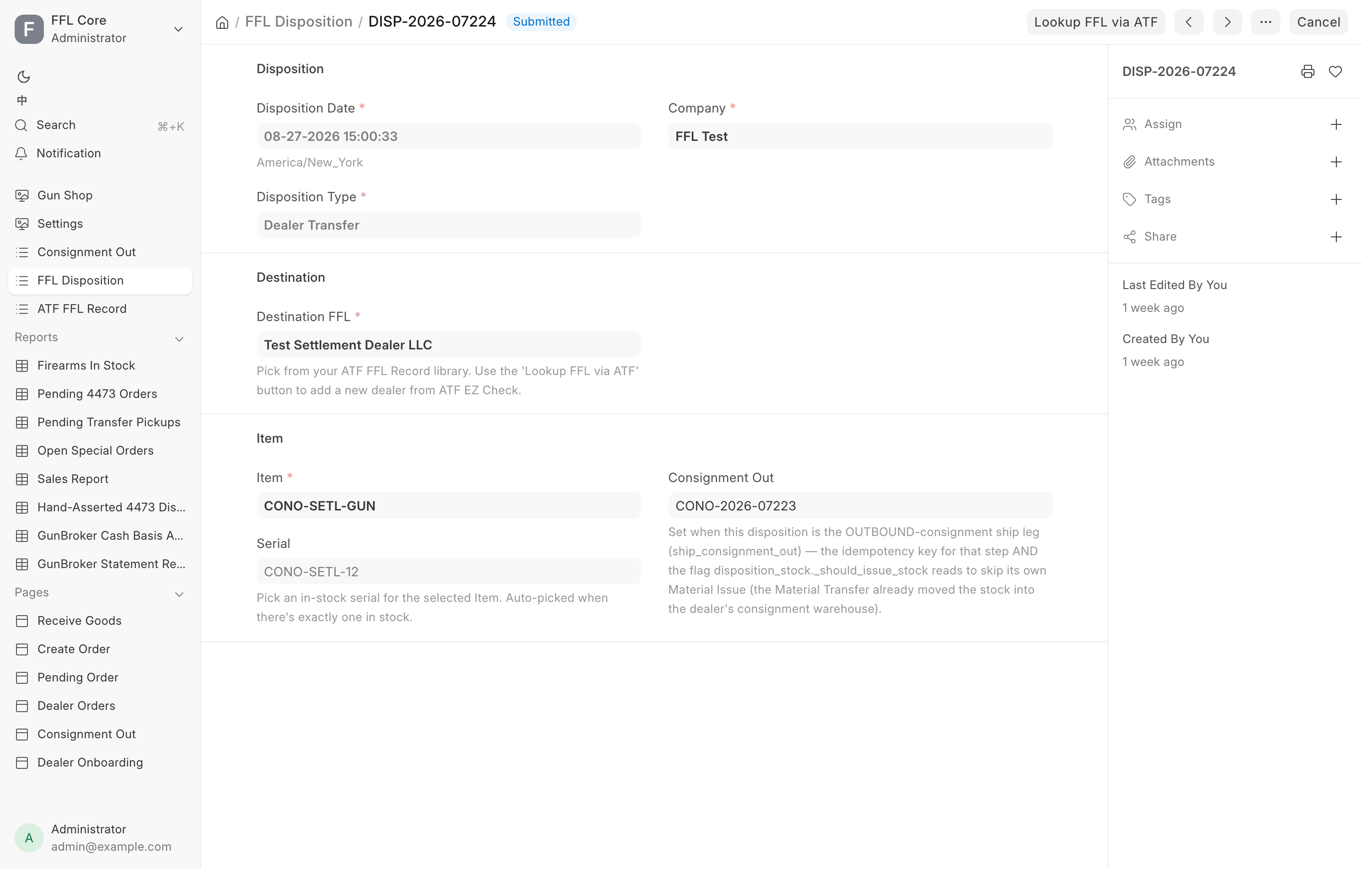
Disposition Type
| Type | Used for |
|---|---|
Retail Sale |
A sale to an individual buyer with a 4473. Created by the register, not by hand. |
FFL Transfer |
Sending a gun to another licensee. |
Return |
Sending a gun back to where it came from. |
Scrap |
Destruction. Both witnesses are required. |
Gunsmithing |
Work by another licensee. |
Dealer Transfer |
A transfer to a dealer. |
NFA |
An NFA transfer. |
The dropdown is replaced by your FastBound account's own disposition list when
FastBound is reachable, so you may see types beyond these. Three are always
removed because they are not supported here: Sale, Donation and
Private Party Transfer. Picking one anyway is refused under
Disposition Type Not Supported, which says to handle that kind of transfer
directly in FastBound.
Retail Sale is hidden from the dropdown on a new record. It is created by the
4473 flow, and creating one by hand is refused under 4473 Handled by
FastBound: "Retail Sale dispositions are created by FastBound after 4473 + NICS
completion — do not create them manually."
Destination
Customer shows and is required for a Retail Sale. Destination FFL shows
and is required for FFL Transfer, Dealer Transfer and Return, and points at
a record in your ATF FFL Record library.
The Lookup FFL via ATF button appears alongside it for exactly those three
types. It opens Lookup Destination FFL via ATF EZ Check, takes an FFL
Number in the format 1-99-999-99-9X-99999 with hyphens optional, and on
Lookup & Use hits the live ATF check, caches the record locally and fills the
field. Next time that dealer is already in the dropdown. See
Verifying an FFL.
For Scrap, a Destruction Witnesses section appears and both Witness 1
and Witness 2 are required.
Item
Item, Serial, and optional links to the Sales Invoice and Sales Order. Changing the item clears a serial that no longer belongs to it, so a leftover value cannot dispose the wrong gun.
Compliance
These fields show for a Retail Sale. The last two appear once the override is ticked.
| Field | Options | Notes |
|---|---|---|
| 4473 Status | N/A, Pending, Completed |
Must be Completed to submit. |
| NICS Status | N/A, Proceed, Delayed, Denied, Cancelled |
Must be Proceed to submit. |
| Manual Override (4473 bypass) | Checkbox | See below. |
| Override Reason | Free text | Required whenever the override is ticked. |
| Override By | Read-only | The user who asserted it. |
Manual Override marks a disposition somebody asserted rather than one FastBound committed. Its description reads: "Set when a manager force-completed the sale because FastBound was unavailable/diverged (the 4473 was completed in FastBound but didn't sync back). Requires Sales Manager / System Manager + a reason."
Federal recordkeeping
The override is not a second gate. A hand-asserted disposition satisfies the sale exactly like a FastBound-committed one, so the marking exists only for the people who read the book afterwards. Every one of them lands on the Hand-Asserted 4473 Dispositions report, which a manager is expected to read back. See Form 4473 and NICS.
Creating a manual-override disposition needs the Sales Manager or System Manager role. The exception is when Paper 4473 Mode is on, where a counter role is enough, because recording the paper form is then the store's ordinary way of working.
When the checks apply
Most checks run at submit, not at save, so a draft can be staged. That is deliberate: it lets a manager stage a transfer and then look the receiving dealer up with Lookup FFL via ATF before submitting.
| Message you see | What it means |
|---|---|
Serial number is required to submit a disposition. |
Pick the gun. |
Serial No <n> does not exist. |
Receive the gun first, or pick from the in-stock list. |
Serial No <n> belongs to Item <a>, not <b>. |
The serial and the item disagree. |
Retail Sale disposition requires 4473 status = 'Completed'. |
The form is not recorded yet. |
Retail Sale disposition requires NICS status = 'Proceed'. |
The check has not cleared. |
Destination FFL number is required for <type> disposition. |
Pick or look up the receiving dealer. |
<type> disposition requires both destruction witnesses |
Fill in Witness 1 and Witness 2. |
A manual-override disposition requires an Override Reason. |
Say why. |
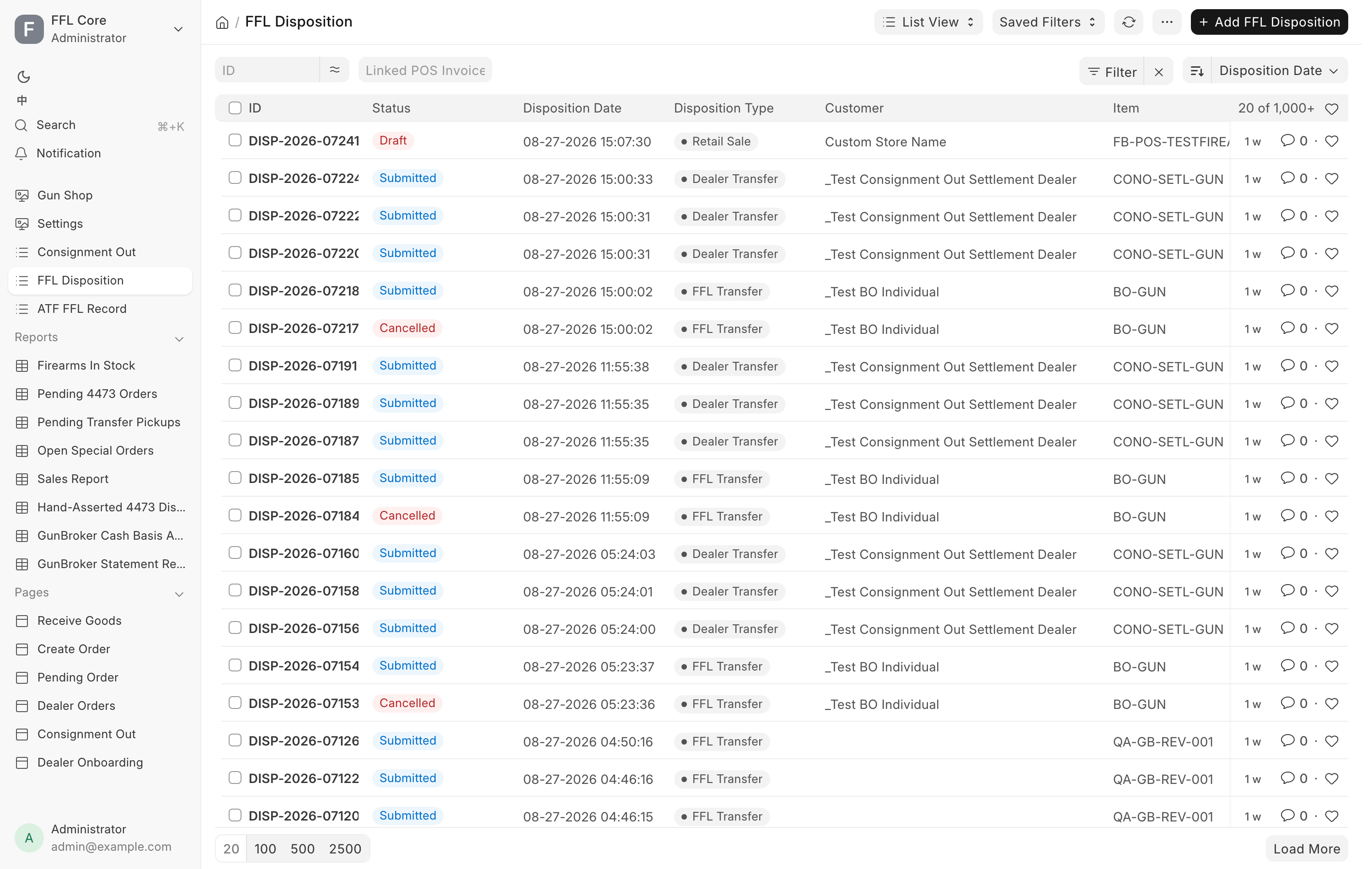
Antique firearms
A gun marked Antique on its item gets no acquisition and no disposition. It is pre-1899 or otherwise exempt, so it never enters the bound book, nothing is pushed to FastBound, and there is no 4473 or NICS check at sale. It is still serialized stock and still shows on Firearms In Stock. See Receive Goods.
Related pages
- FastBound for the sync and its failure modes.
- Form 4473 and NICS for how a retail sale's disposition is created.
- Verifying an FFL for the destination dealer library.
- Daily checks.