Taking payment
How money is collected at the register, and what a manager can do when a card payment goes wrong. Counter staff need the first half. The rest is for managers.
Modes of payment
| Mode | How it settles | What you have to record |
|---|---|---|
| Cash | The drawer | Nothing |
| Credit Card | The Payroc terminal, when the integration is on | Nothing. The approval comes back from the terminal |
| Credit Card | A standalone terminal, when the integration is off | The approval code from the terminal receipt, if the store requires it |
| Zelle | The bank | The Zelle confirmation number, always |
| ACH | The bank | Nothing enforced |
A sale can be split across several modes. Enter an amount against each one on the payment screen before clicking Complete Order.
Zelle
Every positive Zelle amount needs its confirmation number. When you click Complete Order the Zelle Transaction Number dialog asks for it. Dismissing the dialog cancels the checkout, so type the number from the customer's app or the bank and click Confirm. Without it the deposit cannot be matched to the sale later.
Card approval codes on a standalone terminal
If your store swipes cards on a terminal that is not connected to this system, and the store has switched on the requirement, the Card Approval Code dialog asks for the approval code printed on the terminal receipt for this transaction. Refunds are asked too, because a negative card line reverses revenue and sales tax and nothing else records that the money went back.
Never type a card number
The approval code is a short code, usually six to eight characters. It is not the batch number and it is not the last four digits. A value that looks like a card number is rejected, because a card number in an accounting record would turn the ledger into cardholder data.
A sale split across two cards has two approval codes, and the system asks separately for each line.
Charging a card on the Payroc terminal
With the integrated terminal switched on, clicking Complete Order runs the card before the sale is submitted.
- The Card payment dialog opens. Any card already captured on this sale is listed at the top.
- Charge this card is prefilled with the whole remaining card balance. Type a smaller amount to split the sale across more than one card.
- Click Charge.
- Waiting for terminal appears with the amount, and the customer dips or taps their card. Only the Cancel button in the dialog closes it, so a stray click cannot orphan the terminal.
- On approval a green message shows the authorization code, and the loop repeats until the cards cover the card portion.
| What you see | What it means | What to do |
|---|---|---|
| Approved, with an authorization code | The capture landed | Carry on |
| Payment not completed with a decline reason | The card was refused | Try another card or another mode |
| Partial approval of part of the amount | The card only had part of it | A manager reverses the charge, then re-tender |
| Terminal timed out | Two minutes passed with no answer. The charge was cancelled | Retry |
| Terminal error, contact lost while waiting | The connection dropped. The charge was cancelled | Retry |
| Terminal error, could not start the charge | The gateway refused the request | Check the terminal, then retry |
Cancelling mid-charge is safe. If the customer's card raced through to approval anyway, the charge is recorded rather than stranded, and a manager can void it.
Two guards you may hit
Partial approval on file. An earlier attempt captured only part of the amount. That money is recorded and voidable, but the order is not paid. A manager voids it and the sale is re-tendered.
Charged amount mismatch. The card was charged one amount and the Credit Card line now totals another, which means the cart changed after the money moved. This happens most often on a held firearm order that was edited while it waited for a 4473. A manager voids the charge, then re-tender.
The Payroc Charges table
Every card capture on an order is a row in the Payroc Charges table on the POS Invoice. A sale split across three cards has three rows. The single Payroc fields above the table are totals of those rows.
| Column | What it shows |
|---|---|
| Captured Amount | What that card actually took |
| Status | The state of that capture |
| Card | A safe description of the card used |
| Payroc Reference | The gateway's reference for the capture |
| Refunded Amount | How much of that capture has been pushed back |
| Attempt, Instruction ID, Gateway Response | Diagnostics for support |
Nothing in this table is typed by hand. It is written by the payment integration.
Manager actions on a card payment
All three of these are on the POS Invoice in the desk view, not on the register, and all three are limited to Sales Manager and System Manager.
Void Card Charge
Reverses an unsettled card capture and puts the money back on the customer's card. The main use is a held firearm order where the buyer was denied: void the charge, then delete the draft.
- Open the POS Invoice. The button is red and only appears on a Draft.
- If the sale was split across several cards, choose which charge to void. Only one is reversed per click.
- Type a reason, for example a NICS denial or a cancelled sale.
- Click Void the charge.
- Delete the draft, or re-tender the order.
Same business day only
A void works on an unsettled charge, before the batch closes. A settled or submitted sale has to be refunded through a POS return instead. Voiding a submitted sale would leave the books claiming a payment that no longer exists, so the button is not offered there.
Unlock Card Refund
A refund attempt that ended with an unknown outcome locks the return so it cannot be retried blindly. It may or may not have reached the customer's card.
- Check the Payroc portal first and confirm that no refund landed for this return.
- Open the return, click Unlock Card Refund, and write what you verified in the reason box.
- Click I verified in Payroc — unlock.
Unlocking re-arms a full-amount retry. If the first attempt did in fact land, the retry refunds the same money twice.
If the portal shows any refund landed, do not unlock. Send it to the back office instead. A lock that reports some slices already refunded is not unlockable at all: the remainder is settled by hand in the Payroc portal and reconciled on the return.
Confirm Portal Refund
When the card integration has been switched off but the original sale was charged through the terminal, this system cannot send the refund. The return is blocked until the portal refund is recorded.
- Issue the refund in the Payroc portal.
- Open the return and click Confirm Portal Refund.
- Enter the Portal refund reference, which is the refund's own reference from the portal, never a card number.
- Write what you verified, and click I refunded it in Payroc — record.
Recording it lets the return submit. It does not move any money.
The Payments hub
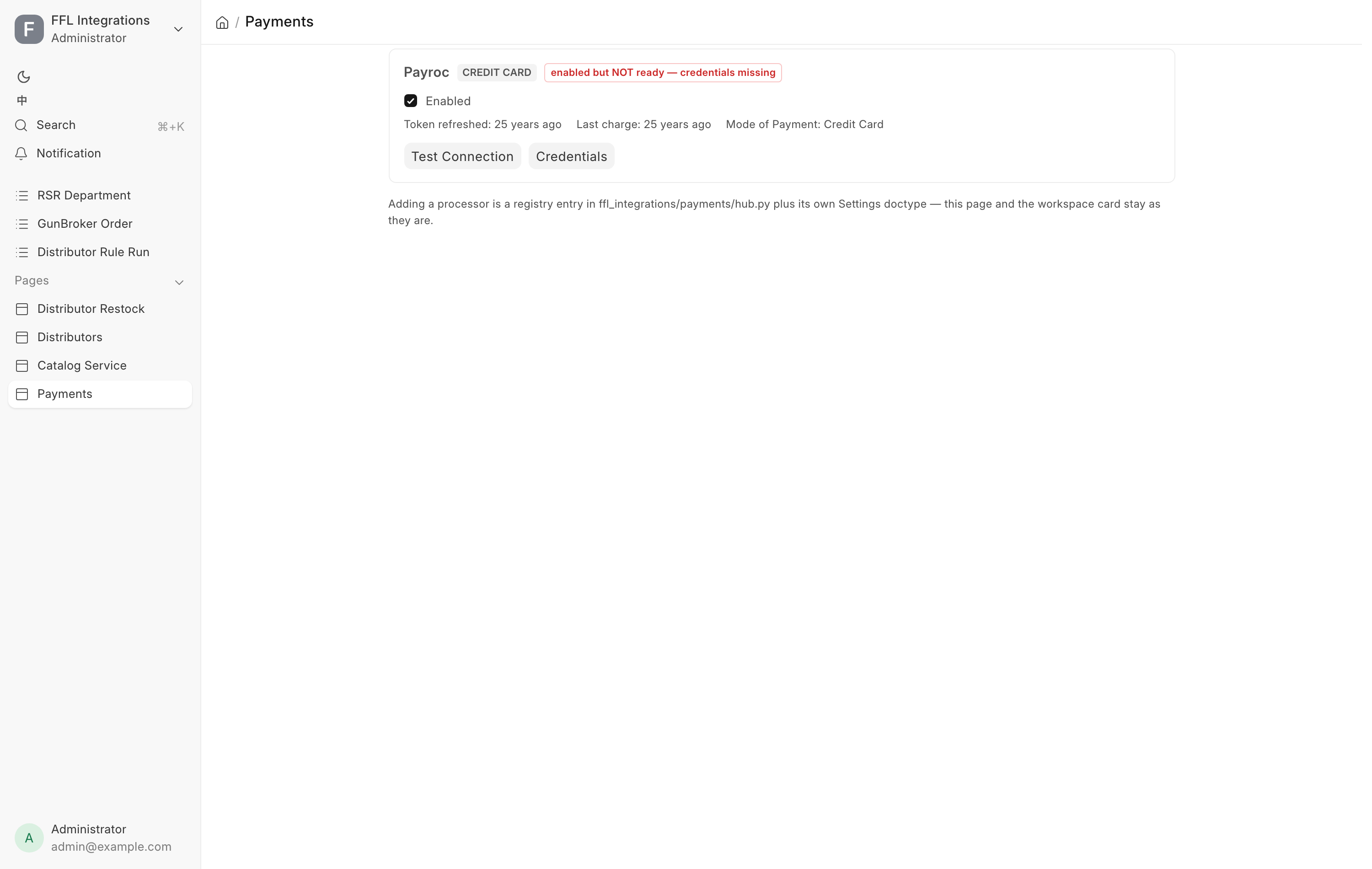
Open Payments (Credit Card) from the Settings workspace, or go to
/app/payment-hub. It is System Manager only, because the switch on it arms
live money movement.
Each processor card shows:
- Whether the integration is switched on.
- Whether it is ready, meaning switched on and holding credentials. A switch can be on while the key is missing, and the card says so rather than claiming it works.
- Token refreshed and Last charge, so you can see whether money is actually flowing.
- A connection test that authenticates against the gateway and reports what it found, including how many terminals the key is allowed to use and which terminal is set as the default.
- A link into the processor's own settings, where the credentials live.
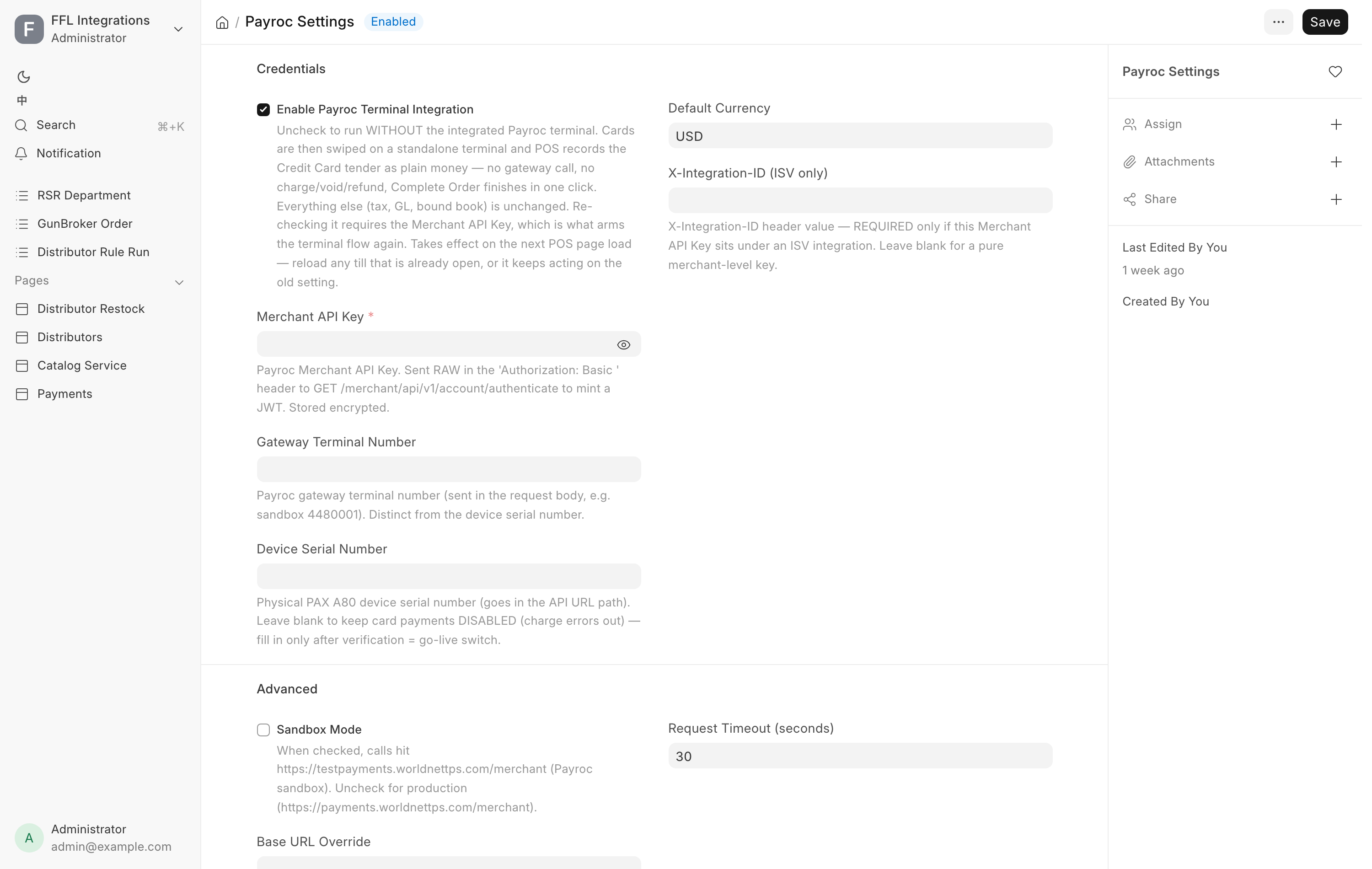
Switching a processor off is always allowed. Switching one on goes through the normal settings save, so a store cannot arm a processor it has no key for. With the integration off, Credit Card stays available as an ordinary mode of payment and the swipe happens on a standalone terminal.
GunBroker refunds are not done here
No screen in this system refunds a GunBroker order, and that is a design decision rather than a gap: GunBroker files the sales tax on those orders under its own license, so only a refund raised on their side moves the state filing with it. Refund on GunBroker first, then mirror the accounting here. See Returns and cancellations and Month-end close.